Showing posts with label 1970s. Show all posts

Saturday, 31 December 2016

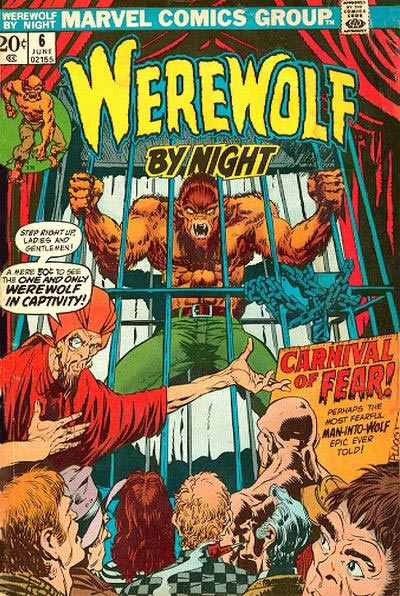
Marvel Spotlight (1971) # 2-4, Werewolf by Night (1972) # 1-19, Giant-Size Creatures (1974) # 1, Tomb of Dracula (1972) # 18


(I originally read these comics in late November 2016)

The Werewolf was the first of Marvel's takes on the traditional horror characters in February 1972, in the pages of Marvel Spotlight # 2.

On her deathbed, eighteen year-old Jack Russell's mother reveals that, far from being a wholesome California kid, he's actually the son of a long-deceased European nobleman and that he's now inherited his father's curse of werewolfism. Under his new, hairy guise he battles and kills the family chauffeur, the man guilty of causing the accident that killed his mother. However, he's helpless to kill the one who designated this grim task - his own stepfather. 


I'll update this entry with better scans when they're available. For now, these are about the best I can find.


The origin story is by Roy and Jeanie Thomas but from there it's Gerry Conway (who's long had a fascination with werewolves), Len Wein and, yes, Marv Wolfman who take up the baton. Jack encounters a succession of stock horror characters during his early adventures including witches, hunchbacked henchmen, the reincarnation of a mad monk and a crooked swami, etc. Having graduated to his own comic, there's the first appearance in issue # 10 of what will prove to be a recurring threat in the Committee, an "organisation of businessmen and financiers, its purpose is to revive our flagging economy... by any means possible, legal or criminal." (Hey, it makes more sense than anything from Paul Krugman.) The minimal supporting cast comes in the shape of Jack's lithesome, younger sister Lissa (who may also stand to inherit the werewolf curse) and middle-aged reporter Buck Cowan. When Marv Wolfman comes aboard as writer with issue # 11, he immediately has Jack settle into his own bachelor pad, presumably because there's a lot of downtime between full moons and his nocturnal rampages. This expands the cast by introducing neighbours composed of two sexy airheads and one brusque gentleman who may have secrets of his own. In that same issue comes the closest thing so far to a costumed super-villain in the scythe-wielding shape of the Hangman, who comes across like a twisted parody of a Ditko hero. Jack's father's association with the mystical book of the Darkhold comes back to haunt him with an encounter with the sorcerer Taboo and his beautiful familiar Topaz in issues 13 and 14. Topaz hereafter becomes Jack's girlfriend, his previous one having shown her face previously only to be immediately forgotten. Wolfman also makes the effort to exonerate Russell's stepfather of any culpability in his wife's death in issue # 14, though whether this is early revisionism or whether it was planned this way from the start is hard to discern. Following this, there's a two-part crossover with the Tomb of Dracula, in which secrets of Jack's Transylvanian lineage are further revealed. The decision to narrate the stories in the first person betrays its limitations when Jack recounts events he wasn't privy to, with captions along the lines of, "I was told later this is what happened..." Groan. The team-up with Tigra in Giant-Size Chillers # 1 is dreadful, but historically important in that it's the comic where Greer Nelson first assumes her furry alias. 

Werewolf by Night is consistently entertaining if you venture in with expectations low. A tendency towards goofy, '70s occultism certainly helps. Artistically, it's mostly well served by the Eisner-esque stylings of Mike Ploog, making his professional comics debut (though inker Frank Bolle absolutely murders his pencils in issue 6), Tom Sutton and Gil Kane, who definitely draws the scariest, most feral-looking version of our furry protagonist. The combined 'efforts' of Werner Roth and Paul Reinman in issue # 8 are abject hackery, and from issue # 17 onwards it's Don Perlin ushering in a dark age of artistic mediocrity.


Marvel Spotlight (1971) # 2-4, Werewolf by Night (1972) # 1-19, Tomb of Dracula (1972) # 18 and Giant-Size Creatures (1974) # 1 are collected in:

Hardcover:

Softcover:

Werewolf by Night (1972) # 1 is collected in:

Softcover:

Werewolf by Night (1972) # 15 and Tomb of Dracula (1972) # 18 are collected in:

Hardcover:

Softcover:

Giant-Size Creatures (1974) # 1 is collected in:

Hardcover:

Softcover:


Sunday, 18 December 2016

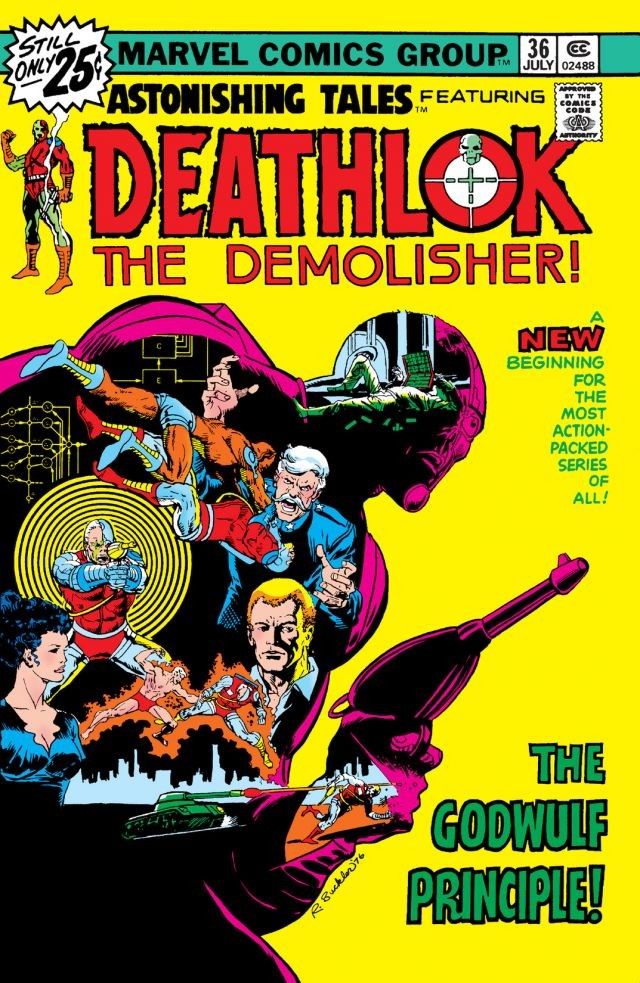
Astonishing Tales (1970) # 25-28/30-36, Marvel Team-Up (1972) # 45/46, Marvel Spotlight (1971) # 33, Marvel Two-In-One (1974) # 27/53-58/60, Marvel Fanfare (1982) # 4


(I originally read these comics between late September/early October 2016)

I've never really warmed to Deathlok. My first exposure to the character was in the 'Captain America: Deathlok Lives' trade back in the '90s and I considered the expository device of the title character, a cyborg, conferring with his onboard computer, its 'speech' lettered in a faux-digital font, a drag. Though these issues have a good reputation among Marvel's 1970s output, I still wasn't won over.

Luther Manning, mortally wounded soldier, wakes up in the distant future of 1990 (lol) to find himself having been rebuilt as a part human/part machine monstrosity called Deathlok. He rebels against his programming by Major Simon Ryker, leader of Project: Alpha-Mech, and discovers his wife has moved on after five years and married his best army bud, something Deathlok doesn't take kindly to despite his now being a reanimated corpse. (Who knows, perhaps even his wedding tackle had rotted off.) I don't think his wife can necessarily be blamed here, but it's just another source of angst for our half-metal hero. 

It's all a bit 'RoboCop before there was RoboCop', just not as good. (And interestingly, that film, in the liquor store scene, gave a nod of acknowledgement to ROM instead.) There's a lot of shooting and running about in these comics, but not much depth. The story's not terribly memorable and has a flying-by-the-seat-of-its-pants quality not uncommon for mid-'70s Marvel. Rich Buckler is the creator and guiding light, but it's mostly Doug Moench and Bill Mantlo handling the scripts. The attempts to extend Deathlok's story in team-up tales don't add much and judging by the character's lack of staying power in any iteration since I can only judge it as a noble failure. 


The character crops up again in 'The Project Pegasus Saga', running through Marvel Two-In-One issues 53-58. This is a more satisfying experience as our ever-loving, blue-eyed Thing takes on a succession of adversaries in defence of the titular energy research facility. Writers Mark Gruenwald and Ralph Macchio depart from the usual 'two heroes clash then team up' formula for the title's first extended storyline, which sees developments for Bill 'Black Goliath' Foster and Steve Gerber's Superman knock-off, Wundarr. Early art from John Byrne and George Perez sure makes it all look pretty. 


Astonishing Tales (1970) # 25-28/30-36, Marvel Team-Up (1972) # 46, Marvel Spotlight (1971) # 33, Marvel Two-In-One (1974) # 27/54 and the back-up strip from Marvel Fanfare (1982) # 4 are collected in: 

Softcover:

Astonishing Tales (1970) # 25-28/30-36, Marvel Team-Up (1972) # 46, Marvel Spotlight (1971) # 33 and Marvel Two-In-One (1974) # 27/54 are collected in: 

Hardcover:

Astonishing Tales (1970) # 25-28/30-35 are collected in:

Softcover:

Astonishing Tales (1970) # 25 is collected in:

Hardcover:

Marvel Team-Up (1972) # 45/46 are collected in:

Softcover:

Marvel Team-Up (1972) # 45 is collected in:

Softcover:

Marvel Two-In-One (1974) # 27 is collected in: 

Softcover:

Marvel Two-In-One (1974) # 53-58/60 are collected in:

Softcover:

Marvel Two-In-One (1974) # 53-58 are collected in:

Hardcover:


Tuesday, 6 December 2016

The Demon (1972) # 1-16


(I originally read these comics in late July 2016)

I took a while reading these. They're consistently enjoyable, but a little undiluted Kirby goes a long way. Jack's prose sometimes flows like a pile of bricks and reads like a poor translation, ie, "TERROR IN TRANSYLVANIA IS A CONDITION AS ANCIENT AS THE STRANGE PRACTICES WHICH PRODUCE IT THERE!"

Come back, Stan...

The plot is as thus: In medieval times, as Camelot is under siege by the evil forces of Morgaine Le Fay, the wizard Merlin conjures up a demon called Etrigan as a last resort to turn the tide in Camelot's favour. But it's to no avail. As the court falls, a change comes over Etrigan and he assumes human guise. Centuries later in modern-day Gotham City, demonologist Jason Blood is about to discover his true nature as Morgaine Le Fay returns to plague the world again. 

That's it, really. Kirby displays his usual propensity for ripping off pop culture in 'The Phantom of the Sewers' in issues 8-10, which has big nods to the Phantom of the Opera, Mad Love and possibly the contemporaneous Dr. Phibes films. The subsequent tale in issues 11-13 introduces a 'Baron Von Evilstein' (groan), assisted by an 'Igor' modelled after Bela Lugosi in Son of Frankenstein. Both stories are stretched out a bit far at three issues each.

The most memorable foes introduced here are Klarion the Witchboy, a malevolent and sorcerous teen, and his cat Teekl.

The problem with Kirby's post-Stan comics for me is that they're just slam-bang action with no quiet moments or respite. They're fun, but the lack of variation in pacing and tone can be wearing. 


(NB: I believe some of these cover reproductions may have been scanned from Kirby's original art and so may or may not always appear as originally published.)


As extras, here's the original art for the cover of The Demon # 1, pencils by Jack Kirby (left) and inks by Mike Royer (right).


The Demon (1972) # 1-16 are collected in:

Hardcover: