Showing posts with label Spider-Man. Show all posts

Monday, 16 January 2017

Marvel Holiday Special 1991/1992/1993/1994/1996, The Howard the Duck! Holiday Special (1997) # 1


(I originally read these comics in late December 2016)

I'm surprised it took so long for Marvel to start putting out an annual 'holiday' special. Up till then, their Christmas stories had been but sporadic offerings in their regular mags, with three 'Holiday Grab-Bag' Treasury Editions in the '70s, though those were mostly reprint. There are informative text pieces detailing the history of these offerings in the first two specials.


The 1991 special features Yuletide tales with the X-Men, Fantastic Four, the Punisher, Thor, Captain America, Ghost Rider, Captain Ultra (?) and Spider-Man. Walt Simonson's Fantastic Four tale is the best, with Franklin Richards encountering a certain chain-rattling, Dickensian spectre, and it has the benefit of Art Adams art... adams.

After Art Adams' cover, Michael Golden's vividly-coloured art is the highlight of the 1992 special. That's allied to a wordless Larry Hama 'story' (and I use the word in its loosest sense) that would seem to want to say something about the equal vividness of children's imagination, but really says nothing. There's a comedic Doc Samson tale from Peter David in which he tries to tell the story of Hannukkah to a classroom of kids but has to think on his feet to retain their interest. The New Warriors, Punisher, Thanos, Iron Man and Spidey stories just fill up pages, but Ann Nocenti's Daredevil story at least tries something different as it's narrated by a toy lamb just purchased by Matt Murdock as a gift. I'd say it's better than it sounds, but it ain't.


The Christmas 1993 issue (labelled '1994') has Nocenti and Tom Grindberg reunite for a Ghost Rider tale which seems to suggest inducing a heart attack in your elderly mother is justifiable if she's an unremitting nag. (I might try it.) There are more lousy tales with Spidey and Captain Ultra (seriously, who the fuck is this guy?), but the Nick Fury and Hulk stories are worth reading. Ultimately, art overshadows story in Howard Chaykin's stylish effort, and the Hulk confronting a would-be suicide with some tough love is better read within the context of Peter David's contemporaneous run (here, for example).

The actual 1994 special leads with an X-Men story by Kurt Busiek and James Fry, a combination that might have worked on Elvira (see here) but which seems ill-suited this time. That said, it's marginally the best story of a weak selection featuring Captain America, the Thing, the Silver Surfer and the X-Men (again) in an illustrated take on 'The Night Before Christmas'. The Thing story just reads oddly now, a decade or more after Ben Grimm was established as a Jew, as he tries to educate a cynical, little Jewish girl as to the true meaning of Christmas.

After a year's hiatus, the 1996 special kicks off with a fairly amusing tale by Mark Waid and Pat Olliffe where Spider-Man and J. Jonah Jameson are forced to spend Christmas evening together. Back-ups include stories with the Silver Surfer, the Rawhide Kid and the X-Men, but it's the Kitty Pryde tale, mawkish though it is, that gets the runner-up prize.


The Howard the Duck Holiday Special by Larry Hama and Pasqual Ferry is pretty... fowl. In it, Howard, his human lady Beverly and an army of department store Santas are rounded up into a makeshift army to foil a hostile takeover of Santa's workshop by HYDRA. Ferry's "art" is typical, eye-searing '90s crap and Hama's script is supposed to be funny - I think. 


Stories from the Marvel Holiday Special 1992 are collected in:

Softcover:
The Silver Surfer: Rebirth of Thanos (US, First Edition)
The Silver Surfer: Rebirth of Thanos (UK, First Edition)
(No current Amazon links)

The Hulk story from the Marvel Holiday Special 1993 is collected in:

Softcover:


Wednesday, 28 December 2016

Morbius the Living Vampire (2013) # 1-9, Amazing Spider-Man (1963) # 699.1


(I originally read these comics in mid November 2016)

After escaping from super-prison the Raft in the pages of Amazing Spider-Man # 699.1, occasional, mostly reluctant Spider-Man antagonist Morbius the Living Vampire settles in the slum area of Brownsville, New York. He soon crosses punk gang leader Noah St. Germain who has mysterious backing, gets blasted in the chest with a shotgun, recovers (obviously) and befriends a street urchin. From here, Morby is gradually established as Brownsville's protector. 


I was halfway through reading this series when it dawned on me I didn't care about the story or the cast. And I'm a Morbius fan. The real Morbius, that is. Though he's still prone to the occasional bout of throat-ripping, make no mistake this is a watered-down, prettified version of the character. (He even lacks the pug nose that Gil Kane originally endowed him with, no doubt so he could draw up-the-nostrils shots from any angle.) The comic as a whole is bland, choosing to depict Michael as a hoodie-wearing bum and playing down any horror aspects. His fellow slum residents (mostly noble minority types, of course) are also far too accepting of a chalk-white, red-eyed bloodsucker amongst them for it to remain credible. Things take a super-heroic turn halfway through with the reveal of St. Germain's benefactor (SPOILER: It's the Rose. Or a Rose, whatever...) and a two-issue guest spot from the Superior Spider-Man. It's around this time Morbius gets an updated costume, no doubt another low sales-inspired concession to traditional, super-hero storytelling. It's too little too late, though, and the series was prematurely truncated after the ninth issue. Writer Joe Keatinge at least gets to wrap everything up neatly and even allows a little ray of hope to penetrate the roiling, black sky of our tortured protagonist's life, but I wouldn't be tempted to seek out more of his work based on this. However the art, mostly by Richard Elson, is very attractive. It's just a shame he never got to illustrate the Morbius I know, ie, the one presented on the first issue cover to (blood)sucker in the horror freaks. 

Morbius the Living Vampire lacks bite. ...Yeah, I said it.


As an extra, here's Ed McGuinness' variant cover for Morbius the Living Vampire #1.


Amazing Spider-Man (1963) # 699.1 and Morbius the Living Vampire (2013) # 1-9 are collected in:

Softcover:

Morbius the Living Vampire (2013) # 1 is collected in:

Hardcover:


Tuesday, 27 December 2016

The Curse of Dracula (1998) # 1-3, Blade (1998) # 1-3, Journey Into Mystery (1952) # 520/521, Blade (1998), Blade: Sins of the Father (1998), Spider-Man Unlimited (1993) # 20, Marvel Team-Up (1997) # 7, Morbius in Dark Corners (1998) # 1


(I originally read these comics in mid November 2016)

'The Curse of Dracula' doesn't come close to recapturing the magic of Marv Wolfman's and Gene Colan's previous Dracula collaboration (and shame on you if you don't know what that is), but is worth reading. As before, Wolfman assembles a band of disparate individuals, all damaged in their own ways, to pursue the vampire count. This Dracula is younger and sexier than the Marvel incarnation and has his eyes on political power as he exerts violent influence over a senator's campaign for presidential office. The story is gorier, Wolfman is less wordy than he was and Colan is looser (and dare I say, sloppier), his art reproduced directly from his pencils. I'll admit to being less of a fan of 'Gene the Dean' than I used to be; his 'scatter the panels on the page and see how they land' approach to layout isn't always to the benefit of story clarity.

Jim Shooter was right.

ANYWAY.


At approximately the same time over at Marvel, vampires were having something of a renaissance. Besides Morbius returning in the pages of Peter Parker, Spider-Man (see here), Marv Wolfman, Christopher Golden and Don McGregor were creating a temporary nexus for the company's Undead. Gene Colan's back for the 1998 Blade one-shot, subtitled 'Crescent City Blues', which sees the vampire hunter decamp to New Orleans on the trail of Deacon Frost, who is muscling in on that city's organised crime. Writer Golden clearly knows his Marvel horror history and Blade's fellow 'Tomb of Dracula' survivor Hannibal King and Brother Voodoo also appear in a wordy adventure that was nevertheless Colan's last association with all three of his co-creations. This leads straight into Spider-Man Unlimited # 20, also by Golden, which follows vampire PI King as he teams up with the webslinger to track Simon Garth, the Zombie, who's in the thrall of Lilith, Dracula's errant daughter.


Marv Wolfman, meanwhile, contributes Marvel Team-Up # 7 and another excursion into the world of vampires for Spidey as he teams with Blade to foil a plot that allows them to walk in sunlight. Then picking up the reins from Golden, he continues the adventures of Hannibal King in two issues of 'Journey Into Mystery', at this brief time an anthology title. King takes on a case that turns out to be more than it seems as he teams with a glamorous CIA agent to thwart an attempt to swell the Undead's numbers via the triggering of chemical weapons. The story's average and Karl Kerschl's art unattractive, but it does provide character development for King as he's tested beyond his limits.

The second Blade one shot published in '98 is by Marc Andreyko and Bart Sears and is a prequel to that year's movie, though you wouldn't know it till the last page and it's easy enough to imagine it takes place within the main Marvel U. The story's fast-moving and action-packed as Blade is hired by the daughter of a vampire mob boss to take down his operation and neutralise a gang war. Bart Sears' art is stylish and Blade looks cooler than he ever has previously. 


Don McGregor's Blade series under Marvel's short-lived 'Strange Tales' banner is a frustrating beast. Preluded in the 'Dark Corners' twelve-page Morbius strip, it sees Blade unwittingly become embroiled in an elaborate plot towards his own destruction that takes in Morbius' wife's family and inevitably brings the two into conflict. Disappointingly, and I'd forgotten this, the series was cancelled with the third issue and the plot never resolved. That's unfortunate, as though Brian Hagan's art is bland, McGregor had something going on. Blade and Morbius next crossed paths in Peter Parker Spider-Man (1999) # 8 and their encounter here was never alluded to.


As an extra, here's Bart Sears' back cover art for the 'Blade: Sins of the Father' one-shot.


The Curse of Dracula (1998) # 1-3 are collected in:

Hardcover:

Softcover:

Blade (1998) # 1 is collected in:

Softcover:


Friday, 25 November 2016

Amazing Spider-Man (1963) # 434-441, Spectacular Spider-Man (1976) # 257-263, Peter Parker, Spider-Man (1990) # 91-98, Sensational Spider-Man (1996) # 27-33, Spider-Man Unlimited (1993) # 20-22, Spider-Man: Made Men (1998)


(I originally read these comics in late May 2016)

Just finished reading the 125 or so Spider-Man comics published within the two-year window between January 1997 and Jan '99 (and a few slightly outside it). This little project took me four weeks. I've enjoyed 'em by and large but I will be glad to move onto something else. 


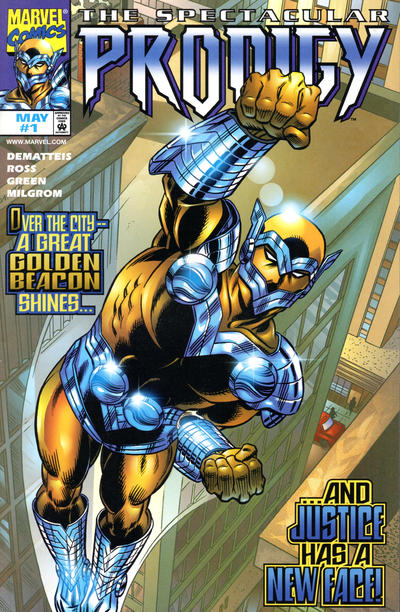
The 'Identity Crisis' crossover follows on directly from 'Spider-Hunt', with Peter assuming four new super-hero guises so he can continue to act while there's a bounty on his head. J.M. DeMatteis leaves as writer of Spectacular Spider-Man for the second time before the story's conclusion, leaving things to be wrapped up by Glenn Greenberg. That's a shame as he's always been one of the best Spidey scribes and he hasn't worked with the character for any extended period since.


The long-running Black Tarantula sub-plot comes to a head in Amazing # 436 (also the climax to Tom DeFalco's second extended run on the title). The character would only turn up again years later in Ed Brubaker's Daredevil run. The newly-revealed Hobgoblin, Roderick Kingsley, and Norman Osborn face off in Roger Stern's 'Goblins at the Gate', a good read, and the Kingpin makes his tentative return to the Big Apple seven years after being toppled from his perch in Howard Mackie's and Norman Felchle's 'Made Men' one-shot. (I guess we're supposed to overlook his recent appearance in 'Spider-Man/Kingpin: to the Death'.) Despite the Spidey logo emblazoned prominently on the front, 'Made Men' features the web-slinger cameoing in only a couple of panels. 


The run climaxes in the double whammy of 'The Gathering of Five' and 'The Final Chapter', which feature Norman Osborn assembling five artifacts needed to perform an arcane ritual through which he hopes to gain ultimate power. Instead he goes insane (insaner?) and in the final showdown with Peter reveals that Aunt May didn't die in the pages of Amazing Spider-Man # 400, after all. No, he'd previously employed a "genetically-engineered actress" to die in her place just to fuck with his mind. Oh, comics...

With Aunt May back and Mary Jane giving up her studies to return to modelling (great role model, there), the way is clear for the Howard Mackie/John Byrne reboot. I read that as it came out and was far from impressed but because I'm some kind of masochist I'll give it another read through soon.


This late 90s stretch of comics is largely a forgotten period in Spidey history, being sandwiched between the infamous Clone Saga and the nearly-as-infamous reboot. There are really no stories that have gone down as classics but that doesn't mean they aren't consistently enjoyable, or at least competent.

One thing I like is how '90s darlings Venom and Carnage are employed sparely. Aside from the two one-shots under his own name, Carnage only makes two appearances. Venom, meanwhile, was coming off the back of a succession of his own limited series and when he does rear his slobbering, fang-filled head it's in the one-shot 'Venom Agenda', and not a regular title. It's as if editorial had finally cottoned on to the fact they're pretty lame characters. Or perhaps not.

Another plus is the number of horror characters Peter gets thrown up against. Morbius gets a handful of appearances. There's also Dracula, Lilith, Frankenstein's Monster, Ghost Rider, Blade and two appearances from Simon Garth, the Zombie. I've always thought Spidey works well in horror settings. 


Sensational Spider-Man # 27, Amazing Spider-Man # 434, Peter Parker, Spider-Man # 91 and Spectacular Spider-Man # 257 were released with variant covers showcasing Peter Parker's alternate super-hero identities. As extras, here are those covers.


Peter Parker, Spider-Man # 98 also came with a variant, second outer cover heralding the character's new direction. 


Sensational Spider-Man (1996) # 27/28, Amazing Spider-Man (1963) # 434/435, Peter Parker, Spider-Man (1990) # 91/92 and Spectacular Spider-Man (1976) # 257/258 are collected in:

Softcover:

Spectacular Spider-Man (1976) # 259-261 are collected in:

Softcover:

Sensational Spider-Man (1996) # 32/33, Amazing Spider-Man (1963) # 440/441, Peter Parker, Spider-Man (1990) # 96-98 and Spectacular Spider-Man (1976) # 262/263 are collected in:

Softcover: