Showing posts with label Gil Kane. Show all posts

Saturday, 31 December 2016

Marvel Spotlight (1971) # 2-4, Werewolf by Night (1972) # 1-19, Giant-Size Creatures (1974) # 1, Tomb of Dracula (1972) # 18


(I originally read these comics in late November 2016)

The Werewolf was the first of Marvel's takes on the traditional horror characters in February 1972, in the pages of Marvel Spotlight # 2.

On her deathbed, eighteen year-old Jack Russell's mother reveals that, far from being a wholesome California kid, he's actually the son of a long-deceased European nobleman and that he's now inherited his father's curse of werewolfism. Under his new, hairy guise he battles and kills the family chauffeur, the man guilty of causing the accident that killed his mother. However, he's helpless to kill the one who designated this grim task - his own stepfather. 


I'll update this entry with better scans when they're available. For now, these are about the best I can find.


The origin story is by Roy and Jeanie Thomas but from there it's Gerry Conway (who's long had a fascination with werewolves), Len Wein and, yes, Marv Wolfman who take up the baton. Jack encounters a succession of stock horror characters during his early adventures including witches, hunchbacked henchmen, the reincarnation of a mad monk and a crooked swami, etc. Having graduated to his own comic, there's the first appearance in issue # 10 of what will prove to be a recurring threat in the Committee, an "organisation of businessmen and financiers, its purpose is to revive our flagging economy... by any means possible, legal or criminal." (Hey, it makes more sense than anything from Paul Krugman.) The minimal supporting cast comes in the shape of Jack's lithesome, younger sister Lissa (who may also stand to inherit the werewolf curse) and middle-aged reporter Buck Cowan. When Marv Wolfman comes aboard as writer with issue # 11, he immediately has Jack settle into his own bachelor pad, presumably because there's a lot of downtime between full moons and his nocturnal rampages. This expands the cast by introducing neighbours composed of two sexy airheads and one brusque gentleman who may have secrets of his own. In that same issue comes the closest thing so far to a costumed super-villain in the scythe-wielding shape of the Hangman, who comes across like a twisted parody of a Ditko hero. Jack's father's association with the mystical book of the Darkhold comes back to haunt him with an encounter with the sorcerer Taboo and his beautiful familiar Topaz in issues 13 and 14. Topaz hereafter becomes Jack's girlfriend, his previous one having shown her face previously only to be immediately forgotten. Wolfman also makes the effort to exonerate Russell's stepfather of any culpability in his wife's death in issue # 14, though whether this is early revisionism or whether it was planned this way from the start is hard to discern. Following this, there's a two-part crossover with the Tomb of Dracula, in which secrets of Jack's Transylvanian lineage are further revealed. The decision to narrate the stories in the first person betrays its limitations when Jack recounts events he wasn't privy to, with captions along the lines of, "I was told later this is what happened..." Groan. The team-up with Tigra in Giant-Size Chillers # 1 is dreadful, but historically important in that it's the comic where Greer Nelson first assumes her furry alias. 

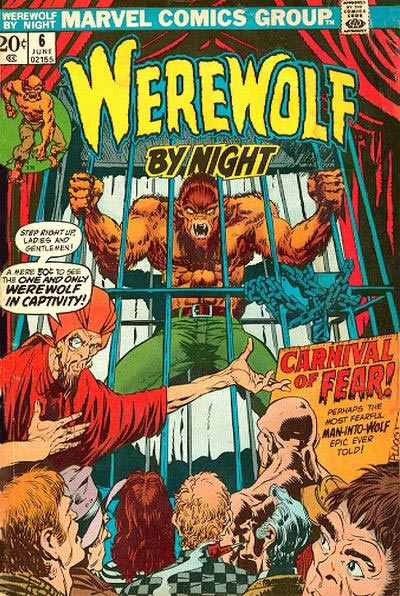
Werewolf by Night is consistently entertaining if you venture in with expectations low. A tendency towards goofy, '70s occultism certainly helps. Artistically, it's mostly well served by the Eisner-esque stylings of Mike Ploog, making his professional comics debut (though inker Frank Bolle absolutely murders his pencils in issue 6), Tom Sutton and Gil Kane, who definitely draws the scariest, most feral-looking version of our furry protagonist. The combined 'efforts' of Werner Roth and Paul Reinman in issue # 8 are abject hackery, and from issue # 17 onwards it's Don Perlin ushering in a dark age of artistic mediocrity.


Marvel Spotlight (1971) # 2-4, Werewolf by Night (1972) # 1-19, Tomb of Dracula (1972) # 18 and Giant-Size Creatures (1974) # 1 are collected in:

Hardcover:

Softcover:

Werewolf by Night (1972) # 1 is collected in:

Softcover:

Werewolf by Night (1972) # 15 and Tomb of Dracula (1972) # 18 are collected in:

Hardcover:

Softcover:

Giant-Size Creatures (1974) # 1 is collected in:

Hardcover:

Softcover:


Thursday, 3 November 2016

Jungle Action (1972) # 6-24, Black Panther (1976) # 14/15, Marvel Premiere (1972) # 51-53


(I originally read these comics in mid March 2015)

I'd been curious about Don McGregor's Black Panther for over twenty years, since first seeing a page reprinted in the 'Marvel: Five Fabulous Decades' book. It's hailed as a highpoint of the company's '70s output, up there with Tomb of Dracula, Warlock, Man-Thing, etc... so I had high expectations. So does it hold up? In a word, no. 

Holy shit, these comics are overwritten. I've seen it referred to as "Marvel's first novel," but if McGregor wanted to write a novel, why was he writing comics? Both have different strengths and weaknesses and McGregor simply didn't know how to play to comics' strengths. There are words crammed into every spare centimetre of white space.

It doesn't even strike me as being well structured. The initial arc, 'Panther's Prey,' runs thirteen issues and the first half dozen issues or so just follow a 'villain of the month' format as the Panther goes up against lieutenants of chief baddie Erik Killmonger, with names like Venomm, Baron Macabre, King Cadaver... All of these characters were new, I believe, but none are very memorable. The plot consists of Erik Killmonger leading a violent rebellion in Wakanda. However, apart from razing one village to the ground early on, he doesn't do much and is a background presence till the end. 

Aside from the 1970s purple prose, which can be poetic but is more often than not just laborious to plough through, the amount of pain dished out to T'Challa borders on parody. Everything's about tearing flesh and dripping blood, delineated in excruciating detail. Despite the complaints, however, it does remain compelling enough to stick with. 


The second arc, 'The Panther vs. the Klan' (referred to as "the Clan" on the covers) is worse. The action's transplanted to Georgia for this one and I felt it would have worked better without the introduction of a second hooded cult whose motivations I never quite understood. 

The storyline was cut short as Marvel, in their wisdom, decided to launch a new Black Panther mag by Jack Kirby, prompting howls of protest from readers who'd enjoyed McGregor's approach. After Kirby left in one of his typical strops, the Klan story was belatedly (and clumsily) concluded by Ed Hannigan in BP # 14 and 15, and then in Marvel Premiere # 51-53, after that title's cancellation. It's dull stuff, and not worth what by then would have been a four year wait. 


Dare I say it, I'm sure this run of comics wouldn't be anywhere near as highly regarded if the protagonist wasn't black.

YEAH, I JUST DID.


Jungle Action (1972) # 6-24 are collected in:

Hardcover:

Softcover:


Tuesday, 13 September 2016

Captain Marvel (1968) # 10-24, Untold Legend of Captain Marvel (1997) # 1-3


(I originally read these comics in May 2015)

I must admit I'm glad to have finally got through these so I could move on to something else. Third rate stuff even by sixties Marvel standards. The first few issues close Arnold Drake's run as writer (from # 5-12) and while he's lauded for his work on DC's 'Doom Patrol,' I've never read anything he wrote for Marvel that was more than mediocre. It's clear this title was launched in a rush (mainly to secure the trademark) and with little prior thought. Captain Marvel's love interest, the drippy 'Medic Una,' is killed off after only a dozen or so issues after proving a total dead-end, story-wise. His nemesis Colonel Yon-Rogg, literally the only slightly memorable villain introduced here, is overused to the point of tedium. Luckily, he too is killed off before the end of this run. Things get trippy and mildly interesting when Gary Friedrich takes over for three issues and puts Mar-Vell in the service of some weird intergalactic entity called 'Zom,' but this story is subsequently wiped away as a conspiracy involving an attempted Kree power coup. Talk about a directionless mess. 

Roy Thomas returns to the series and finally provides some kind of rudder when he teams CM up with everybody's sidekick Rick Jones (fresh from his turn in Captain America as a substitute Bucky), only one of whom can exist on earth at any one time, while the other languishes in the Negative Zone. These issues are dated (with much 'hip teen' slang from Rick), but at least they're readable, if noticeably earthbound. 

The final three issues presented here comprise a limited series from 1997, which serves as an immediate prequel to the '68 series. It's crap.

Oh well. Jim Starlin takes over CM with issue # 25-34 and really gives the series a shot in the arm, so I'll come back to those soon. 

Just as a coda, probably the most (or only) notable aspect of this early CM run is the introduction of Carol Danvers in a supporting role. She would of course go on to have a long shelf life as Ms. Marvel/Binary/Warbird, eventually assuming the 'Captain Marvel' mantle for herself.


Captain Marvel (1968) # 10-21 are collected in:

Hardcover:

Softcover:

Captain Marvel (1968) # 20/21 are collected in:

Softcover:

Captain Marvel (1968) # 17 is collected in:

Softcover:

Captain Marvel (1968) # 19 is collected in:

Hardcover: