Showing posts with label Marvel. Show all posts

Thursday, 26 January 2017

X-Men Origins: Beast (2008) # 1, Colossus (2008) # 1, Jean Grey (2008) # 1, Gambit (2009) # 1, Sabretooth (2009) # 1, Wolverine (2009) # 1, Cyclops (2010) # 1, Deadpool (2010) # 1, Emma Frost (2010) # 1, Iceman (2010) # 1, Nightcrawler (2010) # 1


(I originally read these comics in early January 2017)

You should cherish this post if you're an X-Men fan, because I won't be making many of them. The X-Men and their sundry spin-offs are the Marvel franchise for which I have the least affection. However, that's not to say I don't enjoy some X-Men comics. Given that their convoluted continuity is my main barrier to enjoying them, self-contained, short stories like those in the 'Origins' one-shots should be much more palatable. At least, that's the theory.


Released between 2008 and 2010, each of the comics purports to tell the origin story of a long-standing X-character. In reality, they're really just recaps. Even as a casual (at best) X-fan, there wasn't much here I didn't already know or hadn't read elsewhere. Mike Carey's script for the Beast comic is hampered by having to retell what was already a crappy story with a silly villain. However, the frankly weird art style that looks like painted-over photographs really skewers it. His Gambit book is marginally better (an' I say dis as an avowed Gambit-'ater) and showcases an interesting art style by the combined talents of David Yardin and Ibraim Roberson. The Colossus book is better and has the benefit of moody art by Trevor Hairsine, but content is slim. It's Mike Mayhew's art in the Jean Grey comic that's the standout amongst the first half dozen titles. While I'm no great fan of painted comics, Mayhew's work is simply beautiful, presumably heavy on photo reference but without the stiffness that often results. Jean's journey from traumatised tween to powerful teen telepath is sensitively handled.

There's not much room for sensitivity in the Wolverine or Sabretooth comics, but then that's not what their fans are after. Kieron Gillen's Sabretooth 'origin' doesn't offer much beyond violence, but Dan Panosian's art is great. With more history to recap than most, Chris Yost's Wolverine one-shot is superficial and you'd expect him to have remembered who out of Logan and Colossus he'd had join the X-Men first, instead of having both his efforts blatantly contradict each other.


Of the latter five titles, the ones featuring Cyclops, Nightcrawler and Iceman are the best, though that's not saying much. Jesse Delperdang shines on the art for the Cyclops one-shot, which recaps Scott Summers' background from parents' deaths to assumption of the role of X-Men leader, taking in their first clash with Magneto in the process. The Nightcrawler one at least has a Universal horror film vibe that I appreciated, but the rest are hit or miss. 

Deadpool still sucks. 

One thing that becomes apparent in these stories, to the point of it being a running joke, is just how willing these kids were to ditch their families, maybe forever, to follow a creepy, bald dude. Whether engaging in an endless battle to "protect a world that hates and fears them" or ending up faces frozen in time and staring out from the sides of of milk cartons is the worse fate, I'll leave up to you to decide.


X-Men Origins: Beast (2008) # 1, X-Men Origins: Colossus (2008) # 1, X-Men Origins: Gambit (2009) # 1, X-Men Origins: Jean Grey (2008) # 1, X-Men Origins: Sabretooth (2009) # 1 and X-Men Origins: Wolverine (2009) # 1 are collected in:

Hardcover:

Softcover:

X-Men Origins: Colossus (2008) # 1 and X-Men Origins: Wolverine (2009) # 1 are collected in:

Hardcover:

X-Men Origins: Colossus (2008) # 1 is collected in:

Softcover:

X-Men Origins: Cyclops (2010) # 1, X-Men Origins: Deadpool (2010) # 1, X-Men Origins: Emma Frost (2010) # 1, X-Men Origins: Iceman (2010) # 1 and X-Men Origins: Nightcrawler (2010) # 1 are collected in:

Hardcover:

Softcover:

X-Men Origins: Deadpool (2010) # 1 is collected in:

Hardcover:


Monday, 16 January 2017

Marvel Holiday Special 1991/1992/1993/1994/1996, The Howard the Duck! Holiday Special (1997) # 1


(I originally read these comics in late December 2016)

I'm surprised it took so long for Marvel to start putting out an annual 'holiday' special. Up till then, their Christmas stories had been but sporadic offerings in their regular mags, with three 'Holiday Grab-Bag' Treasury Editions in the '70s, though those were mostly reprint. There are informative text pieces detailing the history of these offerings in the first two specials.


The 1991 special features Yuletide tales with the X-Men, Fantastic Four, the Punisher, Thor, Captain America, Ghost Rider, Captain Ultra (?) and Spider-Man. Walt Simonson's Fantastic Four tale is the best, with Franklin Richards encountering a certain chain-rattling, Dickensian spectre, and it has the benefit of Art Adams art... adams.

After Art Adams' cover, Michael Golden's vividly-coloured art is the highlight of the 1992 special. That's allied to a wordless Larry Hama 'story' (and I use the word in its loosest sense) that would seem to want to say something about the equal vividness of children's imagination, but really says nothing. There's a comedic Doc Samson tale from Peter David in which he tries to tell the story of Hannukkah to a classroom of kids but has to think on his feet to retain their interest. The New Warriors, Punisher, Thanos, Iron Man and Spidey stories just fill up pages, but Ann Nocenti's Daredevil story at least tries something different as it's narrated by a toy lamb just purchased by Matt Murdock as a gift. I'd say it's better than it sounds, but it ain't.


The Christmas 1993 issue (labelled '1994') has Nocenti and Tom Grindberg reunite for a Ghost Rider tale which seems to suggest inducing a heart attack in your elderly mother is justifiable if she's an unremitting nag. (I might try it.) There are more lousy tales with Spidey and Captain Ultra (seriously, who the fuck is this guy?), but the Nick Fury and Hulk stories are worth reading. Ultimately, art overshadows story in Howard Chaykin's stylish effort, and the Hulk confronting a would-be suicide with some tough love is better read within the context of Peter David's contemporaneous run (here, for example).

The actual 1994 special leads with an X-Men story by Kurt Busiek and James Fry, a combination that might have worked on Elvira (see here) but which seems ill-suited this time. That said, it's marginally the best story of a weak selection featuring Captain America, the Thing, the Silver Surfer and the X-Men (again) in an illustrated take on 'The Night Before Christmas'. The Thing story just reads oddly now, a decade or more after Ben Grimm was established as a Jew, as he tries to educate a cynical, little Jewish girl as to the true meaning of Christmas.

After a year's hiatus, the 1996 special kicks off with a fairly amusing tale by Mark Waid and Pat Olliffe where Spider-Man and J. Jonah Jameson are forced to spend Christmas evening together. Back-ups include stories with the Silver Surfer, the Rawhide Kid and the X-Men, but it's the Kitty Pryde tale, mawkish though it is, that gets the runner-up prize.


The Howard the Duck Holiday Special by Larry Hama and Pasqual Ferry is pretty... fowl. In it, Howard, his human lady Beverly and an army of department store Santas are rounded up into a makeshift army to foil a hostile takeover of Santa's workshop by HYDRA. Ferry's "art" is typical, eye-searing '90s crap and Hama's script is supposed to be funny - I think. 


Stories from the Marvel Holiday Special 1992 are collected in:

Softcover:
The Silver Surfer: Rebirth of Thanos (US, First Edition)
The Silver Surfer: Rebirth of Thanos (UK, First Edition)
(No current Amazon links)

The Hulk story from the Marvel Holiday Special 1993 is collected in:

Softcover:


Tuesday, 10 January 2017

The Munsters (1997) # 1-4, Elvira, Mistress of the Dark (1988) # 1, Elvira, Mistress of the Dark (1993) # 1-8


(I originally read these comics in mid/late December 2016)

1997 seems late in the day to attempt a revival of the 1960s spooky sitcom family, but that's what TV Comics! attempted with this four-issue series. And against the odds, it works. All stories are by C.J. Henderson with a total roster of four different pencilers. George Broderick's broad yet accomplished cartooning in issue 1, which somewhat resembles that of Neil Vokes, is my favourite. However, the art style takes a downturn for the "more realistic" in issue 3, seemingly prompted by the reaction of one nobody on the letters page. 


The stories are much what you'd expect, but with more action. A would-be vampire slayer arrives from "the Old Country" in issue 1 to complete his long-held objective. (In this story, it's clearly implied Grandpa is the Dracula. Was this the case in the show?) In issue # 2, the Munsters take a trip to New York and their 'ugly' niece Marilyn (the joke being, of course, that she is actually gorgeous by normal, human standards, ho ho) gets a goth makeover. Issue 3 features a multi-chapter tale with Herman and Eddie attending the latter's school father/son day and Lily going to unusual lengths to prepare dinner for Herman's boss. The fourth and final issue has the Munsters bumbling into an FBI sting at a funfair where they're mistaken for the members of a criminal gang. All issues are padded out with cast photos and interviews and a prose story in issue 1, though I skipped that.

An oddity, worth seeking out for fans.


Still in the mood for spooky silliiness, I read this adaptation of 'Elvira, Mistress of the Dark', a comedy for which I've had a soft spot since renting it on VHS back in about 1989 (though, discovering Elvira's gown-busting norks at the age of thirteen, it was less a "soft spot," more a...). 

I guess the film was considered pretty risque at the time as Sid Jacobson removes the naughtier jokes and the remaining few, such as my fave, "Here's to my big opening!", seem entirely innocuous without Elvira/Cassandra Peterson's nod and wink. Ernie Colon and Romeo Tanghal provide the art but Tanghal seems to me to have overpowered Colon's pencils, which is a shame.

For those not familiar with the movie, TV horror host and frustrated Las Vegas showgirl Elvira, a beehived valley girl with attitude and a goth fashion sense, inherits a house, recipe book and pet poodle from her deceased Aunt Morgana. However, the 'recipe book' is actually her aunt's spell book and Elvira's uncle, an evil warlock, will stop at nothing to gain its power. Horrified at first by Elvira's looks and perceived 'loose ways', the puritanical citizens of sleepy Falwell, Massachusetts are eventually won over when Elvira saves the day, but only after trying to burn her at the stake. The film takes its cues from the then-ongoing battle between the US religious Right and heavy metal culture and provides much more sexy and irreverent fun than the comic.


Elvira's ongoing comic, starting in 1993, is a mixed bag eight issues in. Editor Richard Howell enlists the talents of Paul Dini, Kurt Busiek, Jo Duffy and others to write, with James Fry, Neil Vokes, Jim Mooney and Dave Cockrum among the contributing artists. However, it's Dan Spiegle illustrating Duffy's back-up story in issues 1-6 which is the real eye candy, both in terms of his lush black and white art and his rendition of our heroine, which is definitely the sexiest thus far. A recurring theme is the clashes between Elvira and her station manager at K-WHA, Rosalind Wyck, but there's room for other matters as Elvira helps a teenage werewolf with relationship troubles and attends a class reunion (an idea supposedly contributed by Cassandra Peterson, herself). Paul Dini's stories in issues 1 and 8 were the most amusing to me, but really nothing seems to reach the comedic standard the creators are striving for. Howell's own back-up tale in issue 8 provides a nice, obscure Easter egg for comics fans, though, in that it's an unofficial sequel to Stan Lee's and Steve Ditko's 'Goodbye to Linda Brown', from the pages of Strange Tales # 97, which foreshadows both Spider-Man and the X-Men.

I'll return to this title as I find humour comics are best read in small doses.


As extras, here are Joe Jusko's unadorned front cover art and back cover for Elvira, Mistress of the Dark (1988) # 1


Stories from Elvira, Mistress of the Dark (1993) # 1-8 are collected in:

Softcover:


Saturday, 7 January 2017

Zombie (2006) # 1-4, The Zombie: Simon Garth (2008) # 1-4


(I originally read these comics in mid December 2016)

Marvel's adults only 'MAX' imprint seems to have been the place where a lot of moribund, old characters in need of trademark renewal got a brief shot at revival, with varying success. Unlike some others, this post-Romero updating of the '70s Simon Garth Zombie character is well worth a read. 


Bank Teller Simon Garth is having the worst day of his unremarkable life when two robbers burst into his branch, kill the manager and kidnap Garth and co-worker Layla because they need him to deactivate the paint canisters in their money bags - or so they think. Things get immeasurably worse, however, when the quartet is stopped in their tyre tracks by a chemical spill on the Interstate. This isn't your average chemical spill, though, as it has the effect of turning people into ravenous, undead cannibals, one of which bites Layla's throat out. The remaining trio take refuge in an abandoned burger joint with a rag-tag assortment of new characters, including an infected soldier who will inevitably 'turn', as the chaos outside swells to apocalyptic proportions and the zombie hordes attempt to claw their way in. As always in these situations, everybody's unsure of their allegiances and betrayal might lurk just around the corner. It's spoiling nothing to mention that, yes, Garth does end up infected. 

If you've seen any zombie film made in the last forty-eight years, then you'll find nothing groundbreaking here. However, the story by Mike Raicht is solid and is lifted higher by the atmospheric and super-gory artwork of Kyle Hotz. (You'll feel like you're sloshing ankle-deep through a sea of intestines, by the end.)


Raicht is gone for the follow-up series and I expected a dip in quality as remaining artist Hotz was an unknown quantity to me as a writer. However, he doesn't miss a trick and picks up right after the events of the first series with an infected Simon Garth, now a fully-fledged (yet benevolent) zombie, let loose after his rescue helicopter crashes. From here, another epidemic begins. Hotz has fun introducing a family of inbred hunters modelled after the Texas Chainsaw Massacre's Sawyer clan as adversaries for our zombie hero and now protector of a little girl, lost in the woods after a car crash. Hotz's artwork is as good as ever, like a latter-day Graham Ingels, and if you enjoy the first series you'll want to read this too. Before reading 'Zombie', I considered Hotz to be "like Kelley Jones, just not as good," but I'm forced to revise that opinion now.


Zombie (2006) # 1-4 are collected in:


The Zombie: Simon Garth (2008) # 1-4 are collected in:


Saturday, 31 December 2016

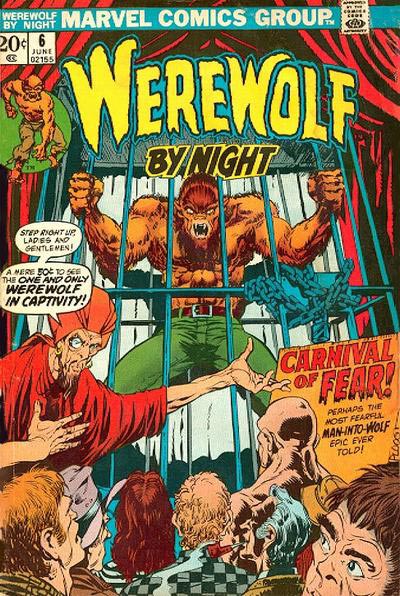
Marvel Spotlight (1971) # 2-4, Werewolf by Night (1972) # 1-19, Giant-Size Creatures (1974) # 1, Tomb of Dracula (1972) # 18


(I originally read these comics in late November 2016)

The Werewolf was the first of Marvel's takes on the traditional horror characters in February 1972, in the pages of Marvel Spotlight # 2.

On her deathbed, eighteen year-old Jack Russell's mother reveals that, far from being a wholesome California kid, he's actually the son of a long-deceased European nobleman and that he's now inherited his father's curse of werewolfism. Under his new, hairy guise he battles and kills the family chauffeur, the man guilty of causing the accident that killed his mother. However, he's helpless to kill the one who designated this grim task - his own stepfather. 


I'll update this entry with better scans when they're available. For now, these are about the best I can find.


The origin story is by Roy and Jeanie Thomas but from there it's Gerry Conway (who's long had a fascination with werewolves), Len Wein and, yes, Marv Wolfman who take up the baton. Jack encounters a succession of stock horror characters during his early adventures including witches, hunchbacked henchmen, the reincarnation of a mad monk and a crooked swami, etc. Having graduated to his own comic, there's the first appearance in issue # 10 of what will prove to be a recurring threat in the Committee, an "organisation of businessmen and financiers, its purpose is to revive our flagging economy... by any means possible, legal or criminal." (Hey, it makes more sense than anything from Paul Krugman.) The minimal supporting cast comes in the shape of Jack's lithesome, younger sister Lissa (who may also stand to inherit the werewolf curse) and middle-aged reporter Buck Cowan. When Marv Wolfman comes aboard as writer with issue # 11, he immediately has Jack settle into his own bachelor pad, presumably because there's a lot of downtime between full moons and his nocturnal rampages. This expands the cast by introducing neighbours composed of two sexy airheads and one brusque gentleman who may have secrets of his own. In that same issue comes the closest thing so far to a costumed super-villain in the scythe-wielding shape of the Hangman, who comes across like a twisted parody of a Ditko hero. Jack's father's association with the mystical book of the Darkhold comes back to haunt him with an encounter with the sorcerer Taboo and his beautiful familiar Topaz in issues 13 and 14. Topaz hereafter becomes Jack's girlfriend, his previous one having shown her face previously only to be immediately forgotten. Wolfman also makes the effort to exonerate Russell's stepfather of any culpability in his wife's death in issue # 14, though whether this is early revisionism or whether it was planned this way from the start is hard to discern. Following this, there's a two-part crossover with the Tomb of Dracula, in which secrets of Jack's Transylvanian lineage are further revealed. The decision to narrate the stories in the first person betrays its limitations when Jack recounts events he wasn't privy to, with captions along the lines of, "I was told later this is what happened..." Groan. The team-up with Tigra in Giant-Size Chillers # 1 is dreadful, but historically important in that it's the comic where Greer Nelson first assumes her furry alias. 

Werewolf by Night is consistently entertaining if you venture in with expectations low. A tendency towards goofy, '70s occultism certainly helps. Artistically, it's mostly well served by the Eisner-esque stylings of Mike Ploog, making his professional comics debut (though inker Frank Bolle absolutely murders his pencils in issue 6), Tom Sutton and Gil Kane, who definitely draws the scariest, most feral-looking version of our furry protagonist. The combined 'efforts' of Werner Roth and Paul Reinman in issue # 8 are abject hackery, and from issue # 17 onwards it's Don Perlin ushering in a dark age of artistic mediocrity.


Marvel Spotlight (1971) # 2-4, Werewolf by Night (1972) # 1-19, Tomb of Dracula (1972) # 18 and Giant-Size Creatures (1974) # 1 are collected in:

Hardcover:

Softcover:

Werewolf by Night (1972) # 1 is collected in:

Softcover:

Werewolf by Night (1972) # 15 and Tomb of Dracula (1972) # 18 are collected in:

Hardcover:

Softcover:

Giant-Size Creatures (1974) # 1 is collected in:

Hardcover:

Softcover: