Showing posts with label Bronze Age. Show all posts

Saturday, 31 December 2016

Marvel Spotlight (1971) # 2-4, Werewolf by Night (1972) # 1-19, Giant-Size Creatures (1974) # 1, Tomb of Dracula (1972) # 18


(I originally read these comics in late November 2016)

The Werewolf was the first of Marvel's takes on the traditional horror characters in February 1972, in the pages of Marvel Spotlight # 2.

On her deathbed, eighteen year-old Jack Russell's mother reveals that, far from being a wholesome California kid, he's actually the son of a long-deceased European nobleman and that he's now inherited his father's curse of werewolfism. Under his new, hairy guise he battles and kills the family chauffeur, the man guilty of causing the accident that killed his mother. However, he's helpless to kill the one who designated this grim task - his own stepfather. 


I'll update this entry with better scans when they're available. For now, these are about the best I can find.


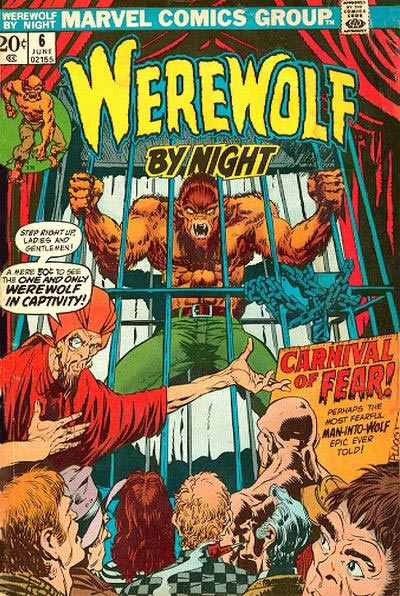
The origin story is by Roy and Jeanie Thomas but from there it's Gerry Conway (who's long had a fascination with werewolves), Len Wein and, yes, Marv Wolfman who take up the baton. Jack encounters a succession of stock horror characters during his early adventures including witches, hunchbacked henchmen, the reincarnation of a mad monk and a crooked swami, etc. Having graduated to his own comic, there's the first appearance in issue # 10 of what will prove to be a recurring threat in the Committee, an "organisation of businessmen and financiers, its purpose is to revive our flagging economy... by any means possible, legal or criminal." (Hey, it makes more sense than anything from Paul Krugman.) The minimal supporting cast comes in the shape of Jack's lithesome, younger sister Lissa (who may also stand to inherit the werewolf curse) and middle-aged reporter Buck Cowan. When Marv Wolfman comes aboard as writer with issue # 11, he immediately has Jack settle into his own bachelor pad, presumably because there's a lot of downtime between full moons and his nocturnal rampages. This expands the cast by introducing neighbours composed of two sexy airheads and one brusque gentleman who may have secrets of his own. In that same issue comes the closest thing so far to a costumed super-villain in the scythe-wielding shape of the Hangman, who comes across like a twisted parody of a Ditko hero. Jack's father's association with the mystical book of the Darkhold comes back to haunt him with an encounter with the sorcerer Taboo and his beautiful familiar Topaz in issues 13 and 14. Topaz hereafter becomes Jack's girlfriend, his previous one having shown her face previously only to be immediately forgotten. Wolfman also makes the effort to exonerate Russell's stepfather of any culpability in his wife's death in issue # 14, though whether this is early revisionism or whether it was planned this way from the start is hard to discern. Following this, there's a two-part crossover with the Tomb of Dracula, in which secrets of Jack's Transylvanian lineage are further revealed. The decision to narrate the stories in the first person betrays its limitations when Jack recounts events he wasn't privy to, with captions along the lines of, "I was told later this is what happened..." Groan. The team-up with Tigra in Giant-Size Chillers # 1 is dreadful, but historically important in that it's the comic where Greer Nelson first assumes her furry alias. 

Werewolf by Night is consistently entertaining if you venture in with expectations low. A tendency towards goofy, '70s occultism certainly helps. Artistically, it's mostly well served by the Eisner-esque stylings of Mike Ploog, making his professional comics debut (though inker Frank Bolle absolutely murders his pencils in issue 6), Tom Sutton and Gil Kane, who definitely draws the scariest, most feral-looking version of our furry protagonist. The combined 'efforts' of Werner Roth and Paul Reinman in issue # 8 are abject hackery, and from issue # 17 onwards it's Don Perlin ushering in a dark age of artistic mediocrity.


Marvel Spotlight (1971) # 2-4, Werewolf by Night (1972) # 1-19, Tomb of Dracula (1972) # 18 and Giant-Size Creatures (1974) # 1 are collected in:

Hardcover:

Softcover:

Werewolf by Night (1972) # 1 is collected in:

Softcover:

Werewolf by Night (1972) # 15 and Tomb of Dracula (1972) # 18 are collected in:

Hardcover:

Softcover:

Giant-Size Creatures (1974) # 1 is collected in:

Hardcover:

Softcover:


Friday, 23 December 2016

Captain America (1968) # 261-300, The Defenders (1972) # 106/107, Marvel Fanfare (1982) # 31/32, Marvel Team-Up (1972) # 128, The Falcon (1983) # 1-4


(I originally read these comics in early/late October 2016)

Picking up what I've long considered to be the J.M. DeMatteis/Mike Zeck run of Captain America after long intending to, I came to discover that's a misnomer. They first combine to good effect in issue # 261, but it's not till later, perhaps # 270, that they start to gel and produce anything very memorable with the introduction of Cap's boyhood friend, Arnie Roth. Once the weakling Steve Rogers' protector, he's now just a tubby, balding schlub whose best years are behind him. You know, like the rest of us. (He's also a 'gay' - but don't whisper it too loudly.) Roth's a worthy addition to Cap's supporting cast, which for a change is quite fleshed out here. In particular, Steve has a romance with neighbour Bernie Rosenthal on the go that experiences its ups and downs when she declares her love for him before he's ready to do the same and also when she finally twigs to his secret identity.

The unstable creative team means the earlier part of DeMatteis' run is littered with fill-in stories by Dave Kraft, though he maintains a decent standard. Issue # 275 memorably introduces Baron Helmut Zemo, son of Cap's wartime nemesis and future Thunderbolt. Rat-man Vermin, now best remembered from 'Kraven's Last Hunt', debuts in # 272. Viper makes a worthwhile return and the writer resurrects forgotten rogue the Scarecrow with some success; less so the Porcupine. The most significant return is that of Jack Monroe, the 1950s Bucky, who after being resuscitated after a long period in suspended animation much like Cap himself, becomes his new crime-fighting partner, Nomad. Issues 286-288 conclude the future saga of cyborg, Deathlok (reviewed in full here). 


DeMatteis' run begins to rumble towards its conclusion as early as # 290 with the debut of Mother Superior, the Red Skull's daughter, though with a pleasing fill-in from Bill Mantlo and an on-form Herb Trimpe in # 291. DeMatteis indulges in some bleeding heart white guilt in # 292 and attempts to make a virtue of pacifism in # 293. In this story, Cap berates Nomad for punching out an armed felon. Let's just repeat that: Cap berates Nomad for punching out an armed bank robber (a "mixed-up kid") WHO WAS POINTING A GUN AT HIM. Oh, well. I guess it was asking too much for DeMatteis to rein in his moronic hippy tendencies forever.

It's around this point my interest started to wane. Paul Neary is not an adequate replacement for Mike Zeck (and he draws some particularly lousy women's faces). The overlong return of, and supposedly final battle with, the Red Skull meanders for too long and proves to be more than a bit anticlimactic. 


The annuals produced during this period are all below par. The later two-issue story in Marvel Fanfare, probably originally intended for DeMatteis' run on Marvel Team-Up, is enjoyable, but then I always did have an inexplicable fondness for guest star, Frog Man. 

One of Marvel's first limited series appeared in 1983, starring Cap's high-flying, sometime-partner the Falcon. It's routine stuff by Jim Owsley (latterly Christopher Priest), Paul Smith and Mark Bright, with Sam Wilson confronting gang-bangers, battling Electro and ending with a kidnapped Ronald Reagan being lectured as to how tough life is in "da hood." Good grief...


As an extra, here's Mike Zeck's cover art for the 1993 trade paperback, 'Captain America: Deathlok Lives'.


Captain America (1968) # 261-266 and Captain America Annual # 5 are collected in:

Softcover:

Captain America (1968) # 261-263 are collected in:

Softcover:

Captain America (1968) # 268 and The Defenders (1972) # 106/107 are collected in:

Softcover:

The back-up strips from Captain America (1968) # 276-278 and The Falcon (1983) # 1-4 are collected in:

Softcover:

Captain America (1968) # 280 is collected in:

Softcover:

Captain America (1968) # 286-268 are collected in:

Hardcover:

Softcover:

Captain America (1968) # 290-300 are collected in:

Softcover: