Showing posts with label Steve Ditko. Show all posts

Wednesday, 21 September 2016

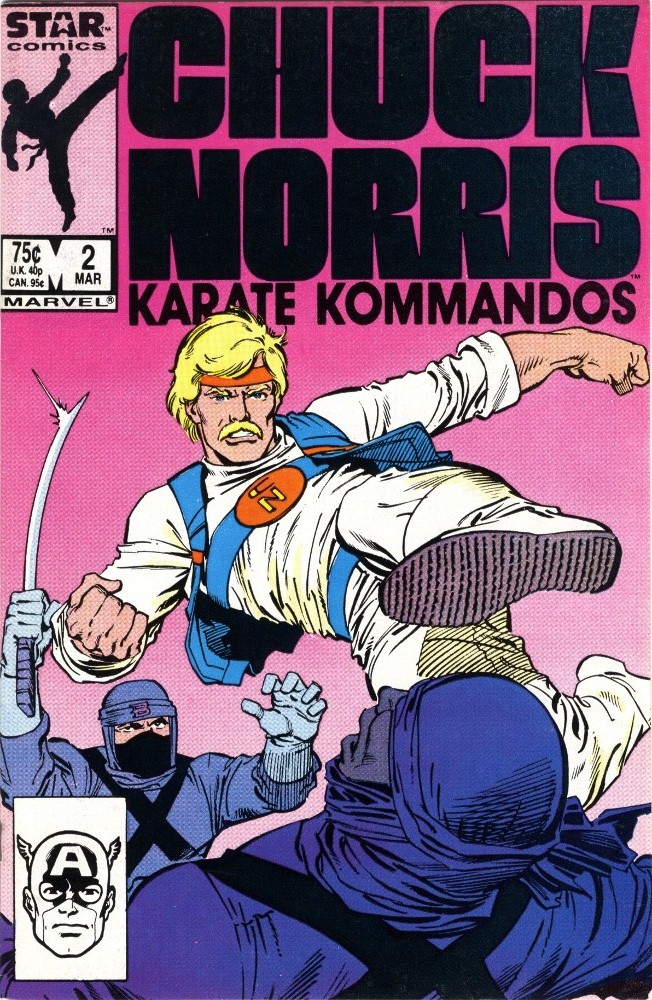
Chuck Norris: Karate Kommandos (1987) # 1-4


(I originally read these comics in late July 2015)

I'm a Chuck Norris fan and I'm a Steve Ditko fan and I ain't even gonna apologise. "Sorry, not sorry," as the kids say.


Based on a short-lived Saturday morning cartoon, this series sees '80s action man Chuck lead his team of Karate Kommandos through various innocuous adventures. The Kommandos are comprised of Chuck, Chuck's moustache, sumo wrestler Tabe, samurai Kimo, teenage brother and sister Reed and Pepper, and irritating kid sidekick 'Too Much.' (Yes, he is.)

The first three issues are clearly pitched at a very young age group, like all of Marvel's Star Comics line. Mary Jo Duffy provides simple plots and Steve Ditko phones it in, permitting a different inker each issue to embellish his pencils with varying success. In the first issue, ninja terrorists the Cult of the Klaw invade Too Much's classroom in order to gain possession of a government super weapon. In the second, the Kommandos protect a supercomputer, the 'Banana 7000' (erm, okay), from Klaw thieves (and Ditko provides a Betty Brant-alike to assist them - both the thieves and then the Kommandos - while making suitably melodramatic hand gestures). The third issue is a change of pace as sumo Tabe relates three apocryphal tales of how he might have first met Chuck.

Duffy and Ditko are suddenly gone come issue # 4, and Howard Mackie and Alex Saviuk open up the comic for a legit action movie scenario. The plot's a degree more complex and the art a few degrees more realistic. Maybe Chuck wasn't a Ditko fan? In which case, I'm gonna say it: fuck Chuck.

Yeah, come get me.


...I get the feeling this cartoon stars Chuck Norris.


Tuesday, 20 September 2016

Topps Comics' 'Kirbyverse'


(I originally read these comics in mid July 2015)

The 'Kirbyverse' titles from Topps Comics were published between 1993-'94 and were developed from unrealised Kirby koncepts. 'Secret City Saga' is the best. Roy Thomas overwrites and Steve Ditko underdraws, with other Marvel Universe founding fathers like Dick Ayers and Don Heck pitching in for its one-shot tie-in titles 'Bombast,' 'Night Glider,' and Captain Glory.' It's very old school, even with contemporaneous touches like the presence of a certain blowjob-loving President as a character, and must have seemed very much out of sync with the likes of the Image explosion.


Secret City Saga trading card art by Steve Ditko and Art Adams


I couldn't even bring myself to read 'Satan's Six,' because the art is some of most grotesque and off-putting I've ever seen in an allegedly professional comic, the few Kirby pages in issue # 1 not withstanding. Take a look at the covers for yourself. It took me literally years to source the three issues of volume two and they won't even get read, the art is so horrific. The fact they still have the death penalty in the US gives me hope that one day "artist" John Cleary will see justice for his crimes committed here.


Kurt Busiek's and Neil Vokes' 'TeenAgents' is just about readable. 'Silver Star' brings back the character originally launched by Pacific Comics in the '80s, and 'Victory' teams up all the Kirbyverse characters in the one comic. The latter two were intended and four and five-issue series respectively, but the line collapsed before they could be completed. 


Jack Kirby died months before those final issues were published. It's probably opening a copy of 'Satan's Six' that did it.


Monday, 5 September 2016

The Question in Blue Beetle (1967) # 1-5, Mysterious Suspense (1968) # 1


(I originally read these comics in March 2015)

Charlton Comics' laissez-faire attitude to editorial oversight provided quite the draw to Steve Ditko upon his departure from Marvel Comics in 1966, even despite the company's notoriously low page rates. Working for Charlton meant Ditko being able to produce his kind of comics his way. He quickly resumed working on Captain Atom and revived Charlton's failed hero the Blue Beetle in the new secret identity of Ted Kord. However, Ditko's most personal and memorable character of the period debuted as a back-up strip only, in Blue Beetle # 1.


There's no origin story given. Ditko plops us straight into the action and all we need to know is imparted via the stories. Vic Sage is a crusading investigative journalist for the World Wide Broadcasting network. Strident and uncompromising, he won't think twice about putting noses out of joint while pursuing the truth. For those times when the famous face of Vic Sage would prove a hindrance, he adopts the identity of the Question, a featureless, blue-suited crusader of justice.

Make no mistake, Sage is less a fully-rounded character and more a conduit for advancing Ditko's ideas, these ideas being inspired by Ayn Rand's Objectivism, a fully integrated system of philosophy incorporating metaphysics, epistemology, ethics, politics and aesthetics. (Rand's magnum opus 'Atlas Shrugged' had been published in 1957 and was still making waves.) Sage isn't Peter Parker; he doesn't fight crime out of guilt or a mistaken sense of responsibility. He isn't a victim. Presumably, Sage's motivation for crime-busting is a rationally selfish one, in line with Rand's ethics; the desire to see justice done and to live in a world (or at least, a city) free of evil. Working upon the Aristotelian axiom of 'A is A,' the Question has no trouble identifying criminals as exactly what they are and judging them accordingly. A bleeding heart, he ain't. This is most evident when he knocks a pair of gunsels into a sewer and is satisfied to watch them be washed away. Maybe they'll live, maybe they won't. What does it matter to the Question? He certainly won't be risking his own neck to save scumbags whom he's judged as "just so much sewage."

Not all Ditko's villains carry guns. Those willing to compromise, to look the other way, to not rock the boat and to refrain from judging are complicit. There's a fine example of a Randian villain in the Banshee, a hanger-on who appropriates the creation of his better as a shortcut to unearned riches. Sage isn't without allies, though; Sam Starr, his boss, stands by him and functions as a kind of anti-J.Jonah Jameson. 

I find the Question works better in shorter tales. In the 'Mysterious Suspense' one-shot, Ditko's didacticism and wordiness make for a bit of a slog. 


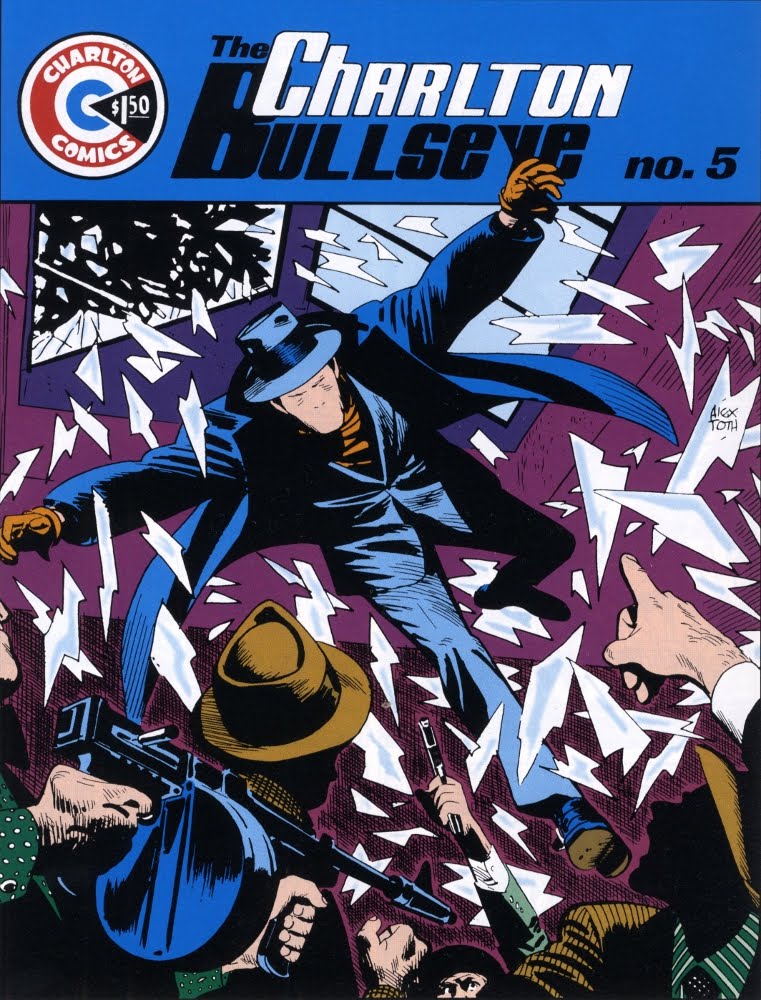
The character made a subsequent appearance in Charlton Bullseye # 5, with art by Alex Toth, before being acquired by DC Comics in 1983. In their Post-Crisis universe, he was revived (and dare I say, perverted) by Denny O'Neil and has since been made into a shadow of his former self by "creators" with no sympathy for Ditko's worldview. That's not the Question I want to read. The original is the only one for me. 


(As a point of interest, the Question shares a look with the masked killer of Mario Bava's 1964 giallo horror film, 'Blood and Black Lace.' Given Ditko is a Bava fan - as confirmed here - the influence would seem undeniable.)


Blue Beetle (1967) # 1-5, Mysterious Suspense (1968) # 1 and Charlton Bullseye (1975) # 5 are collected in:

Hardcover:

Mysterious Suspense (1968) # 1 is collected in:

Softcover: