Showing posts with label Marv Wolfman. Show all posts

Saturday, 31 December 2016

Marvel Spotlight (1971) # 2-4, Werewolf by Night (1972) # 1-19, Giant-Size Creatures (1974) # 1, Tomb of Dracula (1972) # 18


(I originally read these comics in late November 2016)

The Werewolf was the first of Marvel's takes on the traditional horror characters in February 1972, in the pages of Marvel Spotlight # 2.

On her deathbed, eighteen year-old Jack Russell's mother reveals that, far from being a wholesome California kid, he's actually the son of a long-deceased European nobleman and that he's now inherited his father's curse of werewolfism. Under his new, hairy guise he battles and kills the family chauffeur, the man guilty of causing the accident that killed his mother. However, he's helpless to kill the one who designated this grim task - his own stepfather. 


I'll update this entry with better scans when they're available. For now, these are about the best I can find.


The origin story is by Roy and Jeanie Thomas but from there it's Gerry Conway (who's long had a fascination with werewolves), Len Wein and, yes, Marv Wolfman who take up the baton. Jack encounters a succession of stock horror characters during his early adventures including witches, hunchbacked henchmen, the reincarnation of a mad monk and a crooked swami, etc. Having graduated to his own comic, there's the first appearance in issue # 10 of what will prove to be a recurring threat in the Committee, an "organisation of businessmen and financiers, its purpose is to revive our flagging economy... by any means possible, legal or criminal." (Hey, it makes more sense than anything from Paul Krugman.) The minimal supporting cast comes in the shape of Jack's lithesome, younger sister Lissa (who may also stand to inherit the werewolf curse) and middle-aged reporter Buck Cowan. When Marv Wolfman comes aboard as writer with issue # 11, he immediately has Jack settle into his own bachelor pad, presumably because there's a lot of downtime between full moons and his nocturnal rampages. This expands the cast by introducing neighbours composed of two sexy airheads and one brusque gentleman who may have secrets of his own. In that same issue comes the closest thing so far to a costumed super-villain in the scythe-wielding shape of the Hangman, who comes across like a twisted parody of a Ditko hero. Jack's father's association with the mystical book of the Darkhold comes back to haunt him with an encounter with the sorcerer Taboo and his beautiful familiar Topaz in issues 13 and 14. Topaz hereafter becomes Jack's girlfriend, his previous one having shown her face previously only to be immediately forgotten. Wolfman also makes the effort to exonerate Russell's stepfather of any culpability in his wife's death in issue # 14, though whether this is early revisionism or whether it was planned this way from the start is hard to discern. Following this, there's a two-part crossover with the Tomb of Dracula, in which secrets of Jack's Transylvanian lineage are further revealed. The decision to narrate the stories in the first person betrays its limitations when Jack recounts events he wasn't privy to, with captions along the lines of, "I was told later this is what happened..." Groan. The team-up with Tigra in Giant-Size Chillers # 1 is dreadful, but historically important in that it's the comic where Greer Nelson first assumes her furry alias. 

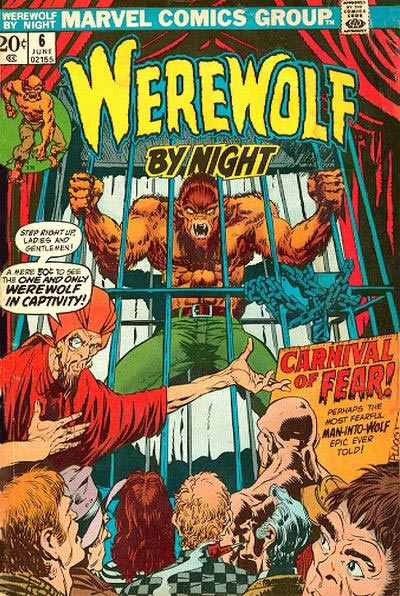
Werewolf by Night is consistently entertaining if you venture in with expectations low. A tendency towards goofy, '70s occultism certainly helps. Artistically, it's mostly well served by the Eisner-esque stylings of Mike Ploog, making his professional comics debut (though inker Frank Bolle absolutely murders his pencils in issue 6), Tom Sutton and Gil Kane, who definitely draws the scariest, most feral-looking version of our furry protagonist. The combined 'efforts' of Werner Roth and Paul Reinman in issue # 8 are abject hackery, and from issue # 17 onwards it's Don Perlin ushering in a dark age of artistic mediocrity.


Marvel Spotlight (1971) # 2-4, Werewolf by Night (1972) # 1-19, Tomb of Dracula (1972) # 18 and Giant-Size Creatures (1974) # 1 are collected in:

Hardcover:

Softcover:

Werewolf by Night (1972) # 1 is collected in:

Softcover:

Werewolf by Night (1972) # 15 and Tomb of Dracula (1972) # 18 are collected in:

Hardcover:

Softcover:

Giant-Size Creatures (1974) # 1 is collected in:

Hardcover:

Softcover:


Tuesday, 27 December 2016

The Curse of Dracula (1998) # 1-3, Blade (1998) # 1-3, Journey Into Mystery (1952) # 520/521, Blade (1998), Blade: Sins of the Father (1998), Spider-Man Unlimited (1993) # 20, Marvel Team-Up (1997) # 7, Morbius in Dark Corners (1998) # 1


(I originally read these comics in mid November 2016)

'The Curse of Dracula' doesn't come close to recapturing the magic of Marv Wolfman's and Gene Colan's previous Dracula collaboration (and shame on you if you don't know what that is), but is worth reading. As before, Wolfman assembles a band of disparate individuals, all damaged in their own ways, to pursue the vampire count. This Dracula is younger and sexier than the Marvel incarnation and has his eyes on political power as he exerts violent influence over a senator's campaign for presidential office. The story is gorier, Wolfman is less wordy than he was and Colan is looser (and dare I say, sloppier), his art reproduced directly from his pencils. I'll admit to being less of a fan of 'Gene the Dean' than I used to be; his 'scatter the panels on the page and see how they land' approach to layout isn't always to the benefit of story clarity.

Jim Shooter was right.

ANYWAY.


At approximately the same time over at Marvel, vampires were having something of a renaissance. Besides Morbius returning in the pages of Peter Parker, Spider-Man (see here), Marv Wolfman, Christopher Golden and Don McGregor were creating a temporary nexus for the company's Undead. Gene Colan's back for the 1998 Blade one-shot, subtitled 'Crescent City Blues', which sees the vampire hunter decamp to New Orleans on the trail of Deacon Frost, who is muscling in on that city's organised crime. Writer Golden clearly knows his Marvel horror history and Blade's fellow 'Tomb of Dracula' survivor Hannibal King and Brother Voodoo also appear in a wordy adventure that was nevertheless Colan's last association with all three of his co-creations. This leads straight into Spider-Man Unlimited # 20, also by Golden, which follows vampire PI King as he teams up with the webslinger to track Simon Garth, the Zombie, who's in the thrall of Lilith, Dracula's errant daughter.


Marv Wolfman, meanwhile, contributes Marvel Team-Up # 7 and another excursion into the world of vampires for Spidey as he teams with Blade to foil a plot that allows them to walk in sunlight. Then picking up the reins from Golden, he continues the adventures of Hannibal King in two issues of 'Journey Into Mystery', at this brief time an anthology title. King takes on a case that turns out to be more than it seems as he teams with a glamorous CIA agent to thwart an attempt to swell the Undead's numbers via the triggering of chemical weapons. The story's average and Karl Kerschl's art unattractive, but it does provide character development for King as he's tested beyond his limits.

The second Blade one shot published in '98 is by Marc Andreyko and Bart Sears and is a prequel to that year's movie, though you wouldn't know it till the last page and it's easy enough to imagine it takes place within the main Marvel U. The story's fast-moving and action-packed as Blade is hired by the daughter of a vampire mob boss to take down his operation and neutralise a gang war. Bart Sears' art is stylish and Blade looks cooler than he ever has previously. 


Don McGregor's Blade series under Marvel's short-lived 'Strange Tales' banner is a frustrating beast. Preluded in the 'Dark Corners' twelve-page Morbius strip, it sees Blade unwittingly become embroiled in an elaborate plot towards his own destruction that takes in Morbius' wife's family and inevitably brings the two into conflict. Disappointingly, and I'd forgotten this, the series was cancelled with the third issue and the plot never resolved. That's unfortunate, as though Brian Hagan's art is bland, McGregor had something going on. Blade and Morbius next crossed paths in Peter Parker Spider-Man (1999) # 8 and their encounter here was never alluded to.


As an extra, here's Bart Sears' back cover art for the 'Blade: Sins of the Father' one-shot.


The Curse of Dracula (1998) # 1-3 are collected in:

Hardcover:

Softcover:

Blade (1998) # 1 is collected in:

Softcover:


Wednesday, 5 October 2016

Doctor Strange (1974) # 14-28, Tomb of Dracula (1972) # 44/45


(I originally read these comics in early/mid September 2015) 

Hmm. Well, I must admit, reading these was something of a slog and has me questioning whether I'm actually a Doctor Strange fan at all! I could only manage one or two issues a day and I couldn't tell you the number of times I felt compelled to break off mid-issue for a snooze (though that possibly says more about me than the comics). Steve Englehart continues as writer with Gene 'The Dean' Colan replacing Frank Brunner as artist and they take the opportunity to have Colan's two contemporaneous assignments cross over with a Doc vs. Drac duel. When Englehart leaves after issue # 18, 'Tomb of Dracula' scribe Marv Wolfman takes over. The annual, drawn by P. Craig Russell, looks gorgeous but is just so much wordy, wispy, hippy wank. Jim Starlin is the latest writer to jump on board the carousel as of # 24, and I found his issues slightly more readable. He hangs around just long enough to introduce the In-Betweener before Roger Stern arrives to finish off his storyline and to begin a long and lauded association of his own with the good doctor. Stern's held in great acclaim as a Doctor Strange writer but I don't have an unbroken run of his issues. I'm hoping they'll be reprinted around the time of the upcoming movie so I can continue onwards. (At the time of posting, it doesn't look good.)


Doctor Strange (1974) # 14-28, Dr. Strange Annual # 1 and Tomb of Dracula (1972) # 44/45 are collected in:

Softcover:

Doctor Strange (1974) # 14-22, Dr. Strange Annual # 1 and Tomb of Dracula (1972) # 44 are collected in:

Hardcover:

Tomb of Dracula (1972) # 44/45 and Doctor Strange (1974) # 14 are collected in:

Hardcover:

Softcover:

Tomb of Dracula (1972) # 44 and Doctor Strange (1972) # 14 are collected in:

Softcover: