(I originally read these comics between late September/early October 2016)
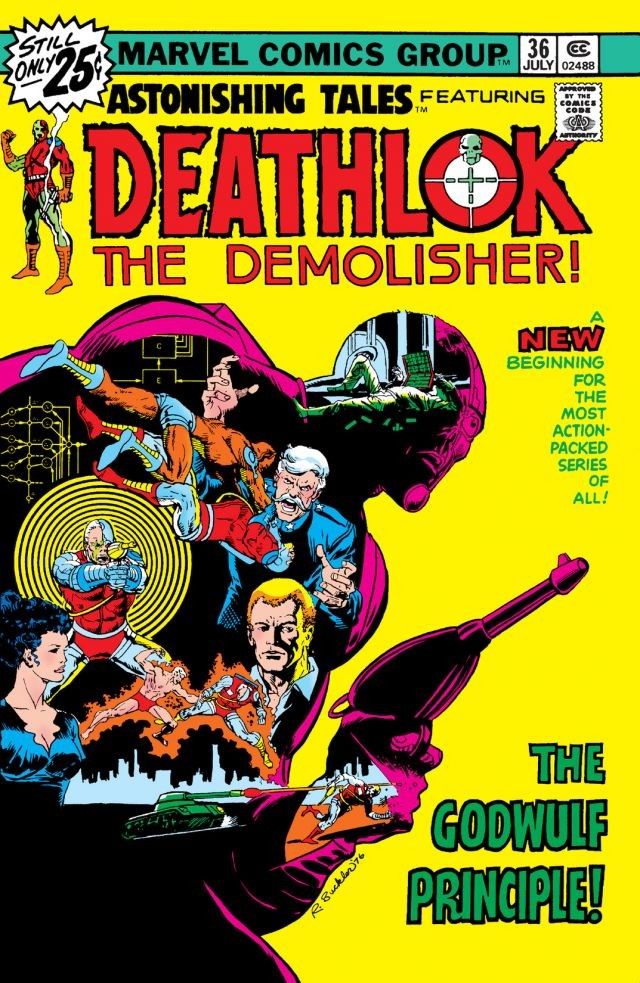
I've never really warmed to Deathlok. My first exposure to the character was in the 'Captain America: Deathlok Lives' trade back in the '90s and I considered the expository device of the title character, a cyborg, conferring with his onboard computer, its 'speech' lettered in a faux-digital font, a drag. Though these issues have a good reputation among Marvel's 1970s output, I still wasn't won over.
Luther Manning, mortally wounded soldier, wakes up in the distant future of 1990 (lol) to find himself having been rebuilt as a part human/part machine monstrosity called Deathlok. He rebels against his programming by Major Simon Ryker, leader of Project: Alpha-Mech, and discovers his wife has moved on after five years and married his best army bud, something Deathlok doesn't take kindly to despite his now being a reanimated corpse. (Who knows, perhaps even his wedding tackle had rotted off.) I don't think his wife can necessarily be blamed here, but it's just another source of angst for our half-metal hero.
It's all a bit 'RoboCop before there was RoboCop', just not as good. (And interestingly, that film, in the liquor store scene, gave a nod of acknowledgement to ROM instead.) There's a lot of shooting and running about in these comics, but not much depth. The story's not terribly memorable and has a flying-by-the-seat-of-its-pants quality not uncommon for mid-'70s Marvel. Rich Buckler is the creator and guiding light, but it's mostly Doug Moench and Bill Mantlo handling the scripts. The attempts to extend Deathlok's story in team-up tales don't add much and judging by the character's lack of staying power in any iteration since I can only judge it as a noble failure.




The character crops up again in 'The Project Pegasus Saga', running through Marvel Two-In-One issues 53-58. This is a more satisfying experience as our ever-loving, blue-eyed Thing takes on a succession of adversaries in defence of the titular energy research facility. Writers Mark Gruenwald and Ralph Macchio depart from the usual 'two heroes clash then team up' formula for the title's first extended storyline, which sees developments for Bill 'Black Goliath' Foster and Steve Gerber's Superman knock-off, Wundarr. Early art from John Byrne and George Perez sure makes it all look pretty.


Astonishing Tales (1970) # 25-28/30-36, Marvel Team-Up (1972) # 46, Marvel Spotlight (1971) # 33, Marvel Two-In-One (1974) # 27/54 and the back-up strip from Marvel Fanfare (1982) # 4 are collected in:
Softcover:
Astonishing Tales (1970) # 25-28/30-36, Marvel Team-Up (1972) # 46, Marvel Spotlight (1971) # 33 and Marvel Two-In-One (1974) # 27/54 are collected in:
Hardcover:
Astonishing Tales (1970) # 25-28/30-35 are collected in:
Softcover:
Astonishing Tales (1970) # 25 is collected in:
Hardcover:
Marvel Team-Up (1972) # 45/46 are collected in:
Softcover:
Marvel Team-Up (1972) # 45 is collected in:
Softcover:
Marvel Two-In-One (1974) # 27 is collected in:
Softcover:
Marvel Two-In-One (1974) # 53-58/60 are collected in:
Softcover:
Marvel Two-In-One (1974) # 53-58 are collected in:
Hardcover:


