Showing posts with label Horror. Show all posts

Thursday, 12 January 2017

Eerie (2012) # 1-8


(I originally read these comics in mid/late December 2016)

This latter-day revival of Warren's long-running horror anthology is a real disappointment. The decision seems to have been made to make it a sci-fi/horror comic, in keeping with the second half of the original mag's run and to distinguish it from Dark Horse's concurrent 'Creepy' revival, but this isn't consistent.

The first issue is an inauspicious debut, with two reprints. I made the decision to skip the reprints in every issue, so as to not spoil them for when I get around to a proper 'Eerie' read-through. Of the two new strips, the lead one by David Lapham, about a paranoid man coming to believe his family are robots, is gruesome and memorable. You'd be hard-pressed to find many jewels in the rest of the run, though, despite the artistic talents of Mike Allred, Evan Shaner and Mike Royer, amongst others. However, the two strips drawn by Kelley Jones in issues 4 and 6 deserve a mention. The first, written by Al Ewing, has a psychotherapist separate a man from his 'shadow self', in order to ease his guilty conscience. The second, an M. R. James adaptation by Jones himself, tells of a condemned witch exacting vengeance through an ash tree. For much of the rest of it, there's an issue with stories requiring too much investment - even over just eight pages or so - for too little pay-off. Bernie Wrightson provides back cover art. 

I bought each issue of this incarnation of Eerie as they were farted out over a period of three and a half years, without reading any. Safe to say, if I'd read them as they came out, I'd have dropped the title from my pull list before it was halfway through. In a time when real life horrors are a staple ingredient of TV news and social media, you have to try much harder than this. I'm afraid 'Eerie' is best left in the past and viewed through the lens of nostalgia where you can at least imagine the world was safer and cosier and that these types of tales still had the power to frighten.


The original stories from Eerie (2012) # 1-8 are collected in:

Softcover:


Saturday, 7 January 2017

Zombie (2006) # 1-4, The Zombie: Simon Garth (2008) # 1-4


(I originally read these comics in mid December 2016)

Marvel's adults only 'MAX' imprint seems to have been the place where a lot of moribund, old characters in need of trademark renewal got a brief shot at revival, with varying success. Unlike some others, this post-Romero updating of the '70s Simon Garth Zombie character is well worth a read. 


Bank Teller Simon Garth is having the worst day of his unremarkable life when two robbers burst into his branch, kill the manager and kidnap Garth and co-worker Layla because they need him to deactivate the paint canisters in their money bags - or so they think. Things get immeasurably worse, however, when the quartet is stopped in their tyre tracks by a chemical spill on the Interstate. This isn't your average chemical spill, though, as it has the effect of turning people into ravenous, undead cannibals, one of which bites Layla's throat out. The remaining trio take refuge in an abandoned burger joint with a rag-tag assortment of new characters, including an infected soldier who will inevitably 'turn', as the chaos outside swells to apocalyptic proportions and the zombie hordes attempt to claw their way in. As always in these situations, everybody's unsure of their allegiances and betrayal might lurk just around the corner. It's spoiling nothing to mention that, yes, Garth does end up infected. 

If you've seen any zombie film made in the last forty-eight years, then you'll find nothing groundbreaking here. However, the story by Mike Raicht is solid and is lifted higher by the atmospheric and super-gory artwork of Kyle Hotz. (You'll feel like you're sloshing ankle-deep through a sea of intestines, by the end.)


Raicht is gone for the follow-up series and I expected a dip in quality as remaining artist Hotz was an unknown quantity to me as a writer. However, he doesn't miss a trick and picks up right after the events of the first series with an infected Simon Garth, now a fully-fledged (yet benevolent) zombie, let loose after his rescue helicopter crashes. From here, another epidemic begins. Hotz has fun introducing a family of inbred hunters modelled after the Texas Chainsaw Massacre's Sawyer clan as adversaries for our zombie hero and now protector of a little girl, lost in the woods after a car crash. Hotz's artwork is as good as ever, like a latter-day Graham Ingels, and if you enjoy the first series you'll want to read this too. Before reading 'Zombie', I considered Hotz to be "like Kelley Jones, just not as good," but I'm forced to revise that opinion now.


Zombie (2006) # 1-4 are collected in:


The Zombie: Simon Garth (2008) # 1-4 are collected in:


Sunday, 1 January 2017

'Breed (1994) # 1-6, 'Breed II (1994) # 1-6, 'Breed III (2011)


(I originally read these comics in early December 2016)

It's 1949 and the army is deployed to investigate strange goings-on in the town of Bucksnort, Texas. Upon reaching the town, Captain Alex Stoner and co. discover a scene of carnage with human remains assembled into a shrine and alien symbols painted on the walls in blood, with just one pregnant survivor. Twenty years later, army photographer and Capt. Stoner's adopted son Ray's true heritage rears its hulking, horned head when he's ambushed in the steaming jungle of Laos. It's only after the war, however, when he stumbles upon a hidden city that he discovers the truth; that he's 'Breed', a human/demon hybrid, and, furthermore, he's the one who it's foretold will destroy all demonkind, making him a constant target of assassins. 

Jim Starlin crafts an interesting mythology here, one that only continues to expand throughout the three series. His art has a rough-hewn, Severin-like quality but is undermined with naff Photoshop effects. The speech balloons and captions are also rife with typos. 


The second series finds Stoner leaving a Nepalese temple and immediately coming under attack by 'brethren'. Dispatching them easily, he disappears to fight in a series of South American wars as a mercenary and to hone his skills as the story moves on into the '80s. However, it's not long till the brethren catch up with him and he must choose on whose side to fight. This chapter concludes with an exciting confrontation among the spires and citadels of the hidden city, Elsewhere. This is the weakest of the three series, with Starlin's art looking rushed. The Photoshop effects dominate and make the pages look sparse. They must have been cutting edge back in the mid-'90s, but have dated badly.


The third and final series, produced by Starlin after a sixteen year break, really kicks things up a notch. This is a much denser read, as though he had a lot of story left to tell in only a set seven issues. Unfortunately, much exposition comes in the way of an extended flashback in the first half of the book that does rob the story of some immediacy. Stoner, in his demon form, comes to the rescue of a woman whose face he's been seeing for years in the still waters of Elsewhere, and her dying, ten year-old son. Just how they figure into what's going on is teased and hinted at until late in the series when Stoner and other guest-starring Starlin creations such as Vanth Dreadstar, Oedi and Kid Kosmos must face a final battle. Things get trippy here with Stoner fighting on a psychic plane of mind-bending, Ditko-esque weirdness, and Starlin renders it all beautifully with no short cuts taken. His art is more refined and detailed here than previously, with less in the way of garish Photoshop effects, though they're still present. 

I found the 'Breed saga in its entirety to be pretty satisfying stuff.


'Breed (1994) # 1-6 are collected in:

Softcover:

'Breed II (1994) # 1-6 are collected in:

Softcover:

'Breed III (2011) # 1-7 are collected in:

Softcover:


Saturday, 31 December 2016

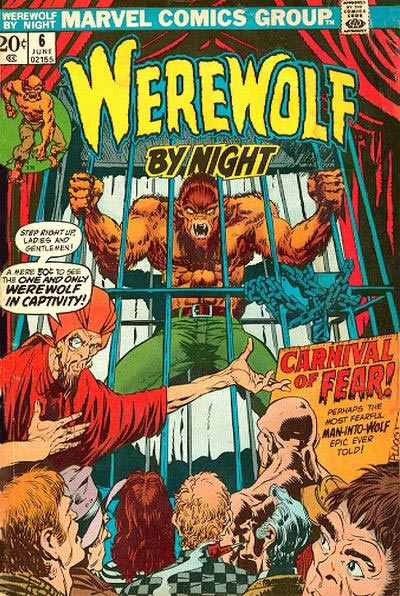
Marvel Spotlight (1971) # 2-4, Werewolf by Night (1972) # 1-19, Giant-Size Creatures (1974) # 1, Tomb of Dracula (1972) # 18


(I originally read these comics in late November 2016)

The Werewolf was the first of Marvel's takes on the traditional horror characters in February 1972, in the pages of Marvel Spotlight # 2.

On her deathbed, eighteen year-old Jack Russell's mother reveals that, far from being a wholesome California kid, he's actually the son of a long-deceased European nobleman and that he's now inherited his father's curse of werewolfism. Under his new, hairy guise he battles and kills the family chauffeur, the man guilty of causing the accident that killed his mother. However, he's helpless to kill the one who designated this grim task - his own stepfather. 


I'll update this entry with better scans when they're available. For now, these are about the best I can find.


The origin story is by Roy and Jeanie Thomas but from there it's Gerry Conway (who's long had a fascination with werewolves), Len Wein and, yes, Marv Wolfman who take up the baton. Jack encounters a succession of stock horror characters during his early adventures including witches, hunchbacked henchmen, the reincarnation of a mad monk and a crooked swami, etc. Having graduated to his own comic, there's the first appearance in issue # 10 of what will prove to be a recurring threat in the Committee, an "organisation of businessmen and financiers, its purpose is to revive our flagging economy... by any means possible, legal or criminal." (Hey, it makes more sense than anything from Paul Krugman.) The minimal supporting cast comes in the shape of Jack's lithesome, younger sister Lissa (who may also stand to inherit the werewolf curse) and middle-aged reporter Buck Cowan. When Marv Wolfman comes aboard as writer with issue # 11, he immediately has Jack settle into his own bachelor pad, presumably because there's a lot of downtime between full moons and his nocturnal rampages. This expands the cast by introducing neighbours composed of two sexy airheads and one brusque gentleman who may have secrets of his own. In that same issue comes the closest thing so far to a costumed super-villain in the scythe-wielding shape of the Hangman, who comes across like a twisted parody of a Ditko hero. Jack's father's association with the mystical book of the Darkhold comes back to haunt him with an encounter with the sorcerer Taboo and his beautiful familiar Topaz in issues 13 and 14. Topaz hereafter becomes Jack's girlfriend, his previous one having shown her face previously only to be immediately forgotten. Wolfman also makes the effort to exonerate Russell's stepfather of any culpability in his wife's death in issue # 14, though whether this is early revisionism or whether it was planned this way from the start is hard to discern. Following this, there's a two-part crossover with the Tomb of Dracula, in which secrets of Jack's Transylvanian lineage are further revealed. The decision to narrate the stories in the first person betrays its limitations when Jack recounts events he wasn't privy to, with captions along the lines of, "I was told later this is what happened..." Groan. The team-up with Tigra in Giant-Size Chillers # 1 is dreadful, but historically important in that it's the comic where Greer Nelson first assumes her furry alias. 

Werewolf by Night is consistently entertaining if you venture in with expectations low. A tendency towards goofy, '70s occultism certainly helps. Artistically, it's mostly well served by the Eisner-esque stylings of Mike Ploog, making his professional comics debut (though inker Frank Bolle absolutely murders his pencils in issue 6), Tom Sutton and Gil Kane, who definitely draws the scariest, most feral-looking version of our furry protagonist. The combined 'efforts' of Werner Roth and Paul Reinman in issue # 8 are abject hackery, and from issue # 17 onwards it's Don Perlin ushering in a dark age of artistic mediocrity.


Marvel Spotlight (1971) # 2-4, Werewolf by Night (1972) # 1-19, Tomb of Dracula (1972) # 18 and Giant-Size Creatures (1974) # 1 are collected in:

Hardcover:

Softcover:

Werewolf by Night (1972) # 1 is collected in:

Softcover:

Werewolf by Night (1972) # 15 and Tomb of Dracula (1972) # 18 are collected in:

Hardcover:

Softcover:

Giant-Size Creatures (1974) # 1 is collected in:

Hardcover:

Softcover: