Showing posts with label John Byrne. Show all posts

Sunday, 18 December 2016

Astonishing Tales (1970) # 25-28/30-36, Marvel Team-Up (1972) # 45/46, Marvel Spotlight (1971) # 33, Marvel Two-In-One (1974) # 27/53-58/60, Marvel Fanfare (1982) # 4


(I originally read these comics between late September/early October 2016)

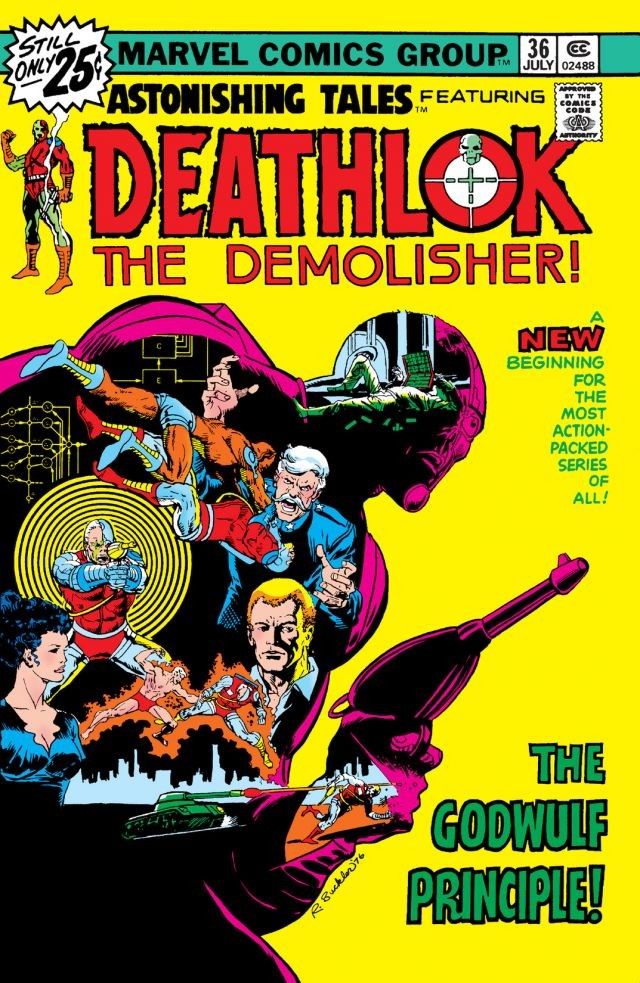
I've never really warmed to Deathlok. My first exposure to the character was in the 'Captain America: Deathlok Lives' trade back in the '90s and I considered the expository device of the title character, a cyborg, conferring with his onboard computer, its 'speech' lettered in a faux-digital font, a drag. Though these issues have a good reputation among Marvel's 1970s output, I still wasn't won over.

Luther Manning, mortally wounded soldier, wakes up in the distant future of 1990 (lol) to find himself having been rebuilt as a part human/part machine monstrosity called Deathlok. He rebels against his programming by Major Simon Ryker, leader of Project: Alpha-Mech, and discovers his wife has moved on after five years and married his best army bud, something Deathlok doesn't take kindly to despite his now being a reanimated corpse. (Who knows, perhaps even his wedding tackle had rotted off.) I don't think his wife can necessarily be blamed here, but it's just another source of angst for our half-metal hero. 

It's all a bit 'RoboCop before there was RoboCop', just not as good. (And interestingly, that film, in the liquor store scene, gave a nod of acknowledgement to ROM instead.) There's a lot of shooting and running about in these comics, but not much depth. The story's not terribly memorable and has a flying-by-the-seat-of-its-pants quality not uncommon for mid-'70s Marvel. Rich Buckler is the creator and guiding light, but it's mostly Doug Moench and Bill Mantlo handling the scripts. The attempts to extend Deathlok's story in team-up tales don't add much and judging by the character's lack of staying power in any iteration since I can only judge it as a noble failure. 


The character crops up again in 'The Project Pegasus Saga', running through Marvel Two-In-One issues 53-58. This is a more satisfying experience as our ever-loving, blue-eyed Thing takes on a succession of adversaries in defence of the titular energy research facility. Writers Mark Gruenwald and Ralph Macchio depart from the usual 'two heroes clash then team up' formula for the title's first extended storyline, which sees developments for Bill 'Black Goliath' Foster and Steve Gerber's Superman knock-off, Wundarr. Early art from John Byrne and George Perez sure makes it all look pretty. 


Astonishing Tales (1970) # 25-28/30-36, Marvel Team-Up (1972) # 46, Marvel Spotlight (1971) # 33, Marvel Two-In-One (1974) # 27/54 and the back-up strip from Marvel Fanfare (1982) # 4 are collected in: 

Softcover:

Astonishing Tales (1970) # 25-28/30-36, Marvel Team-Up (1972) # 46, Marvel Spotlight (1971) # 33 and Marvel Two-In-One (1974) # 27/54 are collected in: 

Hardcover:

Astonishing Tales (1970) # 25-28/30-35 are collected in:

Softcover:

Astonishing Tales (1970) # 25 is collected in:

Hardcover:

Marvel Team-Up (1972) # 45/46 are collected in:

Softcover:

Marvel Team-Up (1972) # 45 is collected in:

Softcover:

Marvel Two-In-One (1974) # 27 is collected in: 

Softcover:

Marvel Two-In-One (1974) # 53-58/60 are collected in:

Softcover:

Marvel Two-In-One (1974) # 53-58 are collected in:

Hardcover:


Monday, 12 December 2016

Hulk (1999) # 1/2, 1-11, Incredible Hulk (2000) # 12-33


(I originally read these comics in mid/late August 2016)

I thought it was about time I picked up the Hulk again, more than a year after finishing the celebrated Peter David run. John Byrne and Ron Garney are the creative talent, but Byrne's gone within a year (no doubt due to another strop). Ron Garney is friggin' awesome but his art is better served when inked by Sal Buscema, as opposed to Dan Green. I bought these issues at the time. 

Their run is a slow-burning one, heavy on captions, with the Hulk laying waste to a small town and downing a jet, resulting in the deaths of hundreds of people. The mystery is why Bruce Banner remembers nothing of it even as he sticks around to help recovery efforts. Turns out he has come under the control of an old foe who is utilising the Hulk's power vicariously like a virtual reality game. The annual is a post-Cold War retelling of the origin and is not bad in itself but is probably as canon now as Byrne's simultaneous (and superfluous) thirteen-issue rehash of Spider-Man's origin, ie, largely dismissed. Garney sticks around after Byrne has gone and their plots are tied up by him and Jerry Ordway.


Paul Jenkins comes on board next for a run which seems to have been well-received but largely left me cold at the time (causing me to drop the book) and I didn't much enjoy it this time around. Banner has contracted Lou Gehrig's disease and, knowing he's going to die, makes a pact with the Hulks (original, grey 'Joe Fixit' version and the amalgamated 'Professor' version) that they will take over his body when he dies. This leaves Jenkins free to use whichever Hulk he feels like using at any time (which I can understand being a plus from his POV) but he also introduces the idea that the three Hulks we've seen previously are just a fraction of potentially thousands, diluting the concept even more. (I was never a fan of the idea of multiple Hulks.) 'The Dogs of War' in issues 14-20 is the highlight of his run, introducing a military opponent who makes even 'Thunderbolt' Ross seem like a milksop in his fanatical zeal. The silly 'Hulk dogs' concept from this story unfortunately made it into Ang Lee's film. Jenkins' 'humorous' stories fail to hit the mark and read like Garth Ennis lite. There's a long overdue confrontation with the Abomination, Betty Banner's killer, in # 24-25, but Jenkins even has to burden what should be a cathartic slugfest with literary pretensions and tiresome psychological window dressing. Utterly rote art by John Romita Jr. doesn't help.


Jenkins (plotting only by this time) wraps up his run with # 32, with Banner miraculously being cured of his disease by another returning foe. (Clue: he's always been something of a bighead.) After a one-issue stopgap by Christopher Priest, succeeding writer Bruce Jones inherits a near-clean slate. 

The 2000 and 2001 annuals are, respectively, a (best left untold) tale of the Hulk in heat wanting to boff his cousin Jennifer (seriously; blame Jenkins) and a retro clash between the Hulk and Thor by Erik Larsen and Jorge Lucas. This should have been a lot more fun than it is, though Lucas' Kirby style art is cool. The back-up strip by James Kochalka only serves to strengthen my opinion that 'alternative comics' are where writers and artists who can't write or draw get published.


Hulk (1999) # 1-11 and Hulk Annual '99 are collected in:

Softcover:

Wolverine (1988) # 144 and Hulk (1999) # 8 are collected in:

Softcover:

The Incredible Hulk (2000) # 12-20 are collected in:

Softcover:

The Incredible Hulk (2000) # 21-33, The Incredible Hulk Annual 2000 and The Incredible Hulk Annual 2001 are collected in:

Softcover:

The Incredible Hulk (2000) # 25 is collected in:

Hardcover:

The back-up strip from The Incredible Hulk Annual 2001 is collected in:

Hardcover:

Softcover:

The Incredible Hulk (2000) # 33 is collected in:

Softcover: